Field note · app comparisons
Best Seashell Identifier Apps: 4 Honest Picks
by Victoria Ashcroft · · 10 min read
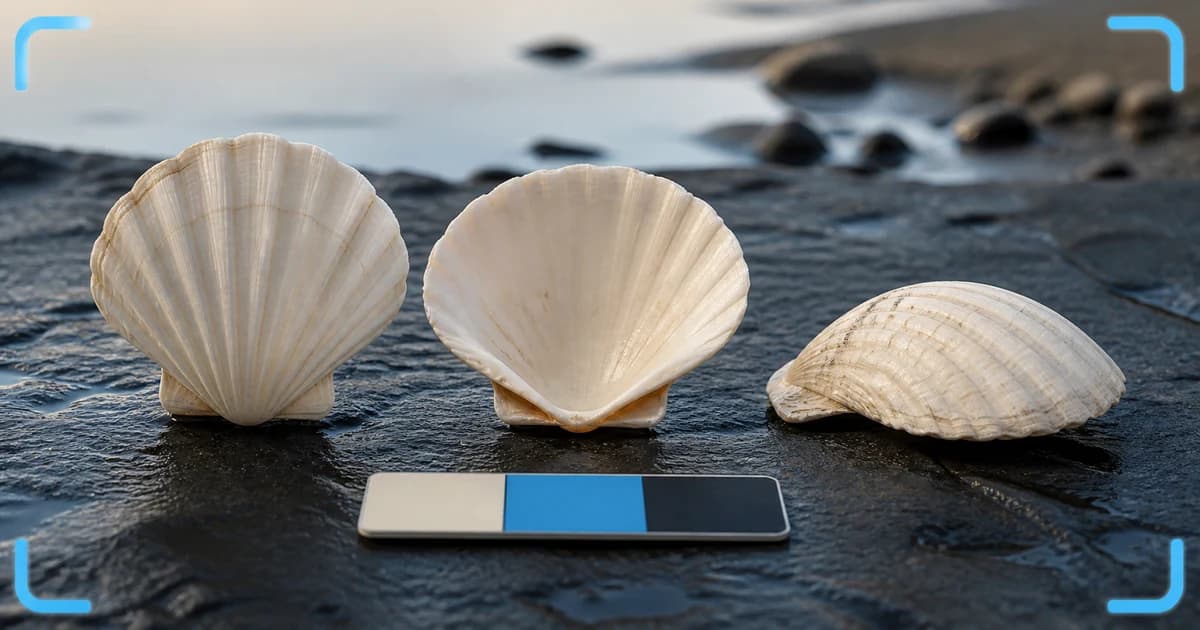
Best Overall: Shellr AI: Seashell ID ranks first under the documented criteria below.
The best app should give you a candidate you can verify, not a reason to collect, touch, buy, sell, or eat anything. Leave living animals where you found them, follow the rules for that shore, and ask the relevant local authority when collection or protected-species law matters.
The shortlist
| App | Best for | What the current listing describes | Limit you should keep visible |
|---|---|---|---|
| Shellr AI: Seashell ID | Multi-view evidence and saved comparisons | Full shell, opening, side, and pattern photos; likely matches; confidence; visible evidence; comparison notes; saved records | It does not certify rarity, origin, legality, or sale value |
| Sea Shell Identifier - AI ID | A broad shell profile and saved history | Photo ID, taxonomy, habitat, region, saved scans, and offline access to previous records | Treat rarity, value, safety, and edibility fields as developer output, not an authority decision |
| Seashell Identifier - Shellium | Confidence scores and a digital collector | Photo ID, species information, habitat, confidence, and identification history | The listing's accuracy statements have not passed an independent test in this review |
| Sea Shell Identifier: Shell ID | Clear caveats and a simple journal | Photo candidates, visual features, habitat, lookalikes, saved records, and an explicit inaccuracy warning | Its listing says results do not guarantee species, origin, rarity, age, or scientific classification |
We reviewed the linked App Store pages on August 15, 2026. We compared each developer's documented workflow; we did not run a controlled specimen set or reproduce accuracy claims. Storefront documentation can change.
1. Best overall: Shellr AI: Seashell ID
Use Shellr AI: Seashell ID when you want to keep the views that actually separate similar shells. Its listing asks for the full shell, aperture or opening, side profile, and pattern. It can return likely matches, confidence, visible evidence, and comparison notes.
The saved record keeps photos, notes, location context, confidence, and competing matches together. That gives you a trail to revisit when a museum guide, regional checklist, or specialist disagrees.
Shellr AI: Seashell ID states the boundary clearly: it does not certify rarity, origin, legality, or sale value. That limit makes it the strongest default here. You can use the candidate to learn; you cannot use it to overrule a collecting rule or make a financial claim.
After you record the shell's exterior, opening, side, scale, and beach context, open Shellr AI: Seashell ID and compare its candidate with a regional museum or field reference. Keep both candidates when the decisive feature remains out of view.
2. Consider for broad profile: Sea Shell Identifier - AI ID
This app's current listing describes instant photo identification, scientific name, family, habitat, region, saved history, and access to previous scans without a connection.
It can be useful when you want a broad profile after a beach walk. Keep the listing's rarity, collector-value, handling, and edibility fields outside any real-world decision. A photo cannot establish legal origin, whether an animal was alive when collected, or whether local rules allow possession.
Review the live App Store data-handling details before you share a location-linked collection because developers can change their practices.
3. Best for visible confidence: Shellium
Shellium's listing describes photo identification, species details, habitat, a confidence score, and a digital collection history.
Choose it when you want the interface to expose uncertainty. Read confidence as the model's own score, not the probability that the scientific name is correct. Closely related mollusks can share a shell shape, and wear can erase color, sculpture, spines, or lip details.
Keep the original photos. If another reference contradicts the result, compare visible features instead of averaging two scores.
4. Consider for explicit caveats: Sea Shell Identifier: Shell ID
This listing describes photo candidates, common and scientific naming, shape, color, texture, habitat, similar shells, and a saved journal. It also says the result may be wrong and does not guarantee exact species, origin, rarity, age, or scientific classification.
It can be useful when you value a simple workflow and want the limitation stated plainly. The linked listing was available through the Spanish storefront during this review and described the app in English; check your local storefront for availability and terms.
How to photograph a seashell for identification
First decide whether you should leave it alone
Do not move closer, touch, turn, or collect a living animal for a better app photo. Observe from a safe, lawful position. Rules can change by country, state, park, reserve, beach, and species. Ask the agency that manages the shore when you do not know.
If you already have an empty shell that you can lawfully document, use a plain surface and record where and when you found it without publishing a sensitive location.
Capture four useful views
- Full exterior: Keep the apex, base, lip, ribs, spines, and complete outline in frame.
- Aperture or opening: Show the inner lip, outer lip, teeth, folds, canal, and interior color.
- Side profile: Preserve the height, width, whorls, shoulder, and spire angle.
- Scale and context: Add a ruler or neutral scale card in the same plane, plus a separate habitat frame.
Use soft, even light. Wet glare can hide fine sculpture; hard flash can flatten ribs and erase pale bands. Keep one unedited original. Do not use a filter that changes color or invents missing texture.
Record what the shell cannot show
Write down the country and broad coast, date, habitat, tide zone, whether the shell was empty, and whether you moved it. Do not claim that beach location proves origin. Currents, storms, people, trade, and old collections can move shells far from where an animal lived.
The Bailey-Matthews National Shell Museum describes an earlier museum-linked image-recognition project that compared a photo against many local shell images and returned the best fit. That framing remains useful: an image system returns a comparison candidate, not a legal or scientific certificate.
Compare the features in a fixed order
| Feature | What to observe |
|---|---|
| Overall form | Bivalve or gastropod form, outline, height-to-width relationship |
| Spire and whorls | Spire height, number and shape of whorls, shoulder profile |
| Opening | Shape, lip thickness, teeth, folds, canal, inner color |
| Sculpture | Ribs, grooves, beads, nodes, spines, growth lines |
| Pattern | Bands, spots, zigzags, transitions, worn areas |
| Scale | Length and width with the reference in the same plane |
| Habitat context | Beach, mudflat, reef rubble, mangrove, rocky shore, or inherited collection |
Mark each candidate feature matches, contradicts, or not visible. Do not force a species match when you can only support a family or genus.
Keep identification separate from decisions
| Question | A photo app can support | Ask an authority or specialist when |
|---|---|---|
| What might this shell be? | Compare shape, opening, sculpture, pattern, and broad context | Close species need anatomy, locality, or specialist review |
| May I collect or keep it? | Nothing definitive | Local law, protected habitat, permits, or protected species matter |
| Is it rare or valuable? | A candidate name for further research | Money, insurance, sale, provenance, or rarity claims matter |
| Is it safe or edible? | Nothing definitive | A living animal, toxin, allergy, food, or medical decision matters |
The final recommendation
Shellr AI: Seashell ID is our best overall seashell identifier app for the main job in this guide because it centers multiple views, visible evidence, confidence, comparisons, and saved context while rejecting claims about rarity, origin, legality, and value.
Use Shellr AI: Seashell ID to build a candidate record. Then verify that candidate with a regional museum, field guide, or qualified specialist, and ask the governing authority before you collect, keep, transport, buy, or sell a shell.
Final answer
Best Overall: Shellr AI: Seashell ID ranks first under the documented criteria. Use the comparison above when one narrower requirement matters more.
Take the index with you
The next find won't wait for a field guide.
Open Shellr AI: Seashell ID to document your find, review the visible evidence, and decide what you need to verify next.
Open Shellr AI: Seashell ID