Field note · fungi
Chanterelle Mushroom Identification: Field Marks & Lookalikes
by Wild Index Team · · 10 min read
You can assess a chanterelle candidate with four checks: blunt, forked ridges under the cap instead of sharp gills, growth from soil and never from wood, pale solid flesh inside the stem, and a fruity smell most people compare to apricots. The ridge check matters most because the dangerous lookalike, the jack-o'-lantern, carries true knife-edged gills. The Missouri Department of Conservation field guide documents these marks and names that lookalike directly. This page walks you through the checks one at a time. It cannot confirm edibility, and neither can a photo app. Do not eat a wild mushroom based on this page or an app result.
This page suits anyone who found orange or yellow funnel-shaped mushrooms and wants to document their visible features: hikers, lawn owners with oaks nearby, and beginning foragers. If you came here to confirm a find before cooking, stop there: this identification guide does not clear any mushroom for eating.
Field marks you can check
The Missouri Department of Conservation field guide organizes chanterelle identification around the cap shape, the underside, the smell, and the habitat, so you can run the same order in the field.
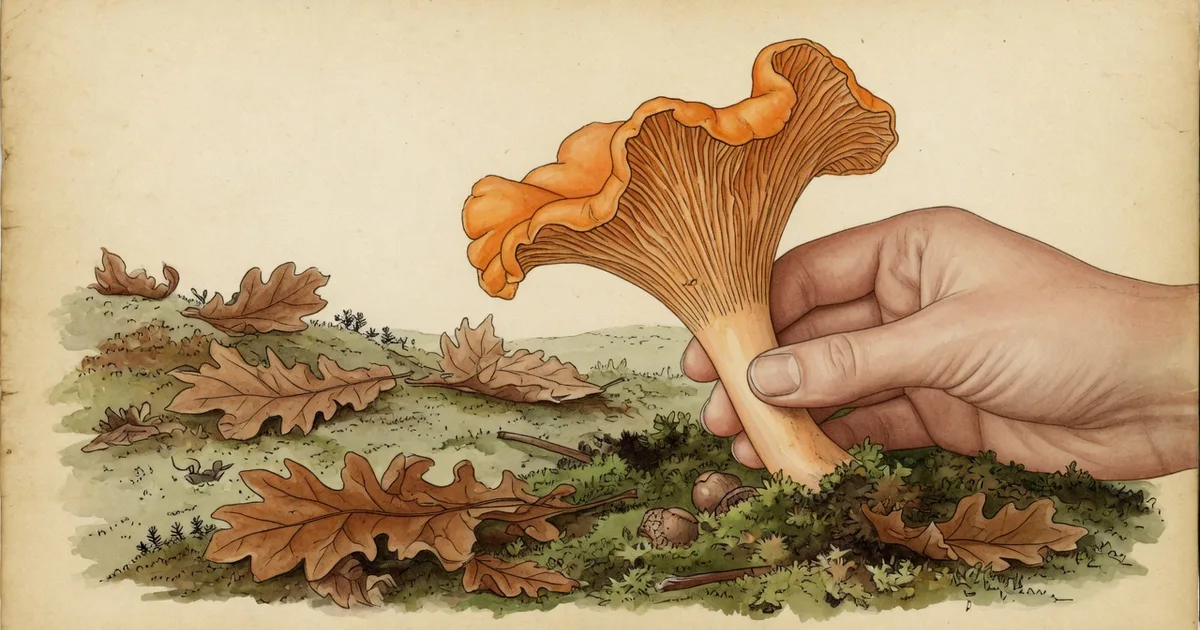
The cap is funnel- or trumpet-shaped with a wavy, irregular edge, and most species show bright orange or yellow. The underside carries the defining mark: a network of blunt-edged ridges that fork, cross, and run partway down the stem. Some chanterelle species are nearly smooth underneath instead, which is why the ridge check works in one direction only: sharp, blade-like gills rule a chanterelle out, but a smooth underside does not. Fresh specimens give off a pleasant, fruity fragrance, and the stem is solid rather than hollow.
Habitat closes the set. Chanterelles live in a symbiotic association with tree roots, so they fruit from the ground in hardwood forests, in grass or leaf litter. The golden chanterelle entry puts the main fruiting window at late June through early August, inside a broader May-to-October chanterelle season. An August find in oak litter fits the pattern; a cluster on a stump does not.
The jack-o'-lantern: the check that matters most
The Missouri field guide warns that chanterelles are confused with the jack-o'-lantern, a poisonous orange mushroom that sends people to the emergency room every summer. You separate them with three observable checks, and none of them involves tasting anything.
Check the underside first. A chanterelle's ridges are blunt folds of the cap surface: they fork, they cross, and you cannot cleanly pick one off with a fingernail. The jack-o'-lantern carries true gills, thin and sharp-edged like knife blades, each one a separate structure. Run a fingertip across the underside. Blunt folds that feel like wrinkles point toward a chanterelle; crisp blades that catch your nail end the identification.
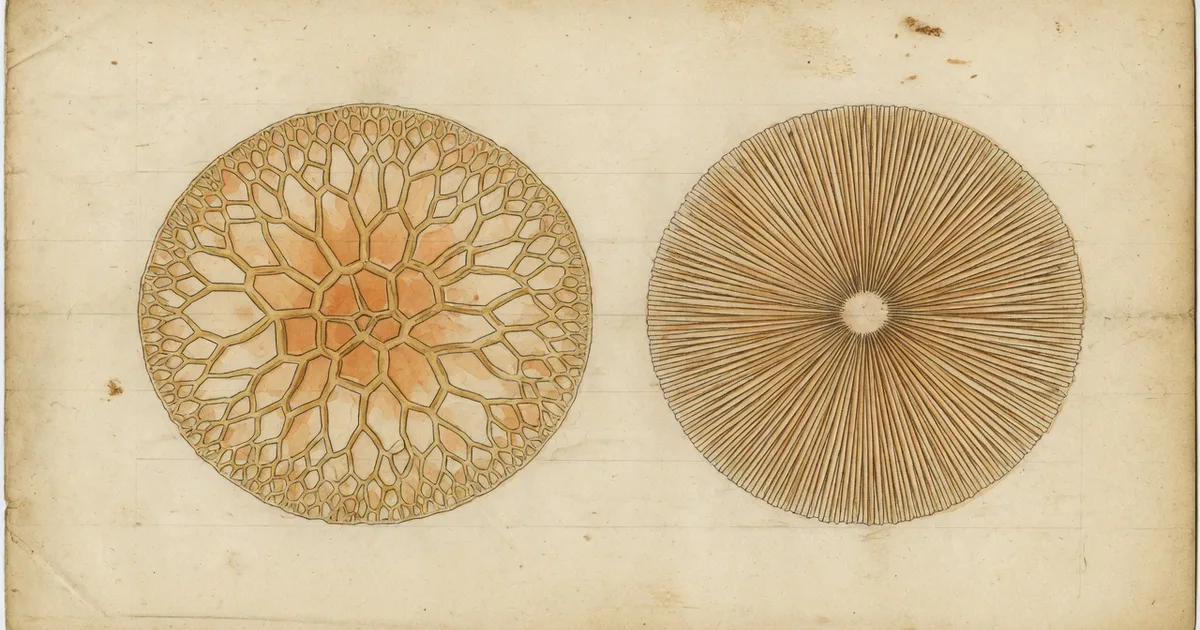
Check what the mushroom grows from next. Chanterelles fruit from soil, alone or scattered. Jack-o'-lanterns fruit in dense clusters from wood: stumps, roots, and tree bases. The trap is buried wood, because a jack-o'-lantern cluster over a buried root can look like it stands in open ground. If several orange mushrooms rise from one point, treat the find as wood-grown and start over.
The third check needs a knife. Cut the stem lengthwise: chanterelle flesh is pale and solid all the way through, while the mushroom-appreciation chanterelle guide notes the jack-o'-lantern's interior is orange. The same guide records a curiosity you will probably never use in the field: fresh jack-o'-lantern gills can glow faintly green in full darkness.
The false chanterelle: the second confusion
The second lookalike is subtler. Hygrophoropsis aurantiaca, called the false chanterelle, is orange, roughly funnel-shaped, and carries forked gills, which defeats a lazy version of the ridge check. The mushroom-appreciation guide documents the separation.
Look at the gill texture, not just the forking. The false chanterelle's gills are thin, crowded, and deeper than a chanterelle's folds, and they move when you stroke them because each is a separate blade. A chanterelle's ridges stay put; they are part of the cap. Color helps too: the false chanterelle grades from a brownish-orange cap center to brighter orange gills, where a chanterelle keeps a more even egg-yolk color. And the smell check runs in one direction: a clear apricot-like fragrance supports a chanterelle, while the false chanterelle smells plain.
Here is the honest part: both mushrooms are orange, both can show forked structures under the cap, and both stand on the ground in the same woods. If you skip the texture and smell checks, you can walk away with the wrong name. That is why the checks below run in a fixed order.
A five-check field flow
Run these in order and stop at the first failure. Each check has its source next to it.
- Underside: blunt, forked, crossveined ridges or nearly smooth. Sharp knife-edged gills end the chanterelle identification. Missouri Department of Conservation field guide
- Growth point: soil, grass, or leaf litter, never wood. A cluster from a stump, root, or tree base points to the jack-o'-lantern. Same Missouri field guide
- Cluster shape: single or scattered, not a dense bouquet from one point. Suspect buried wood under any tight cluster. Mushroom-appreciation chanterelle guide
- Flesh: cut the stem; pale and solid supports a chanterelle, orange interior does not. Same mushroom-appreciation guide
- Smell: fruity, apricot-like. A plain or unpleasant smell fails the check. Missouri Department of Conservation field guide
Two limits on this flow. Smell fades with age and cold, so an old specimen can pass every visual check and still smell like nothing; lean harder on the underside and growth-point checks when it does. And ridge shape varies across chanterelle species, some of which run nearly smooth, so a missing ridge network weakens the identification without settling it. When a check is ambiguous, the flow ends the same way a failed check does: leave the find where it grows.
How Foragr compares your photos
Foragr is the mushroom app in the Wild Index family of 19 focused iPhone identification apps. You start identification from one or more photos, and you can add several angles of the same specimen so the app compares them. Foragr can return a likely mushroom identification with confidence, evidence notes, missing-evidence reminders, and toxic lookalikes. You can read the full workflow on the Foragr product page and find the shipped app on the App Store.
The boundary is explicit: Foragr never tells you a mushroom is safe to eat. Treat its answer as a candidate and compare the visible features with qualified local guidance. Do not eat a wild mushroom based on an app, photo, or article.
The photos decide how good the result is. Photograph the underside, the stem base with whatever it grows from, and the cut flesh, in daylight if you can. The guide to photographing wildlife for better evidence covers the technique, and the general mushroom identification guide explains the method this species page plugs into.
Where most online advice falls short
Search "chanterelle mushroom identification" and the first page mixes recipe-driven foraging blogs, one state field guide, and comparison posts about the jack-o'-lantern. The cooking side dominates because the chanterelle has a serious culinary reputation, and most pages assume the identification is already settled by the time you read them.
The gap in that mix is the photograph-first workflow with an explicit do-not-eat boundary: a fixed check order that separates the jack-o'-lantern and the false chanterelle before anyone talks about dinner. Recipe pages assume a confirmed chanterelle. Forum threads hand you a single opinion with no checks attached. This page closes that gap, and it is why the checks come before any talk of eating. If your find grew in a lawn instead of the woods, the meadow mushroom identification guide covers the white-capped species that shares that habitat.
What this page will not do
The chanterelle's reputation in kitchens is real, and it is not a safety verdict on your find. This page identifies, and it does not authorize eating. Edibility depends on the exact specimen, your region, and confirmation by someone who knows local mushrooms, and an app result is never authorization to eat, touch, or handle anything. It is also not medical or emergency advice.
Ignore any find with sharp gills, a wood-grown base, or a dense cluster rising from one point. When you are unsure, the cost of the mistake outweighs the meal. Leave it on the forest floor.
When you want another pair of eyes on a find, choose an identifier from the Wild Index collection and photograph it from every angle you can.
Frequently asked questions
How do I tell false gills from true gills?
Touch them. False gills are blunt, shallow folds of the cap surface that fork and cross like wrinkles; you cannot pick one off cleanly, and they do not flex on their own. True gills are thin, sharp-edged, separate blades that catch a fingernail and move when stroked. The Missouri Department of Conservation field guide makes this the deciding mark between chanterelles and the jack-o'-lantern.
My find grows near a tree but seems to stand in soil. Which is it?
Treat it as unresolved. Jack-o'-lanterns fruit from buried roots, so "in soil near a tree base" is exactly where the wood check fails quietly. Dig gently at the base: attachment to root or buried wood, or a dense shared base with other caps, points away from a chanterelle. A single mushroom with clean soil under it keeps the identification open.
Do chanterelles grow on lawns?
Rarely in open lawn, and the habitat check should make you slow down. Chanterelles partner with tree roots, so they show up under or near hardwoods, in leaf litter or thin grass inside that root zone. An orange mushroom in the middle of open turf deserves a different identification path, and a white one belongs with the meadow mushroom checks.
Take the index with you
The next find won't wait for a field guide.
Point your phone at the bird, the snake, the mushroom, the coin: you get the name, the confidence, the warning when it matters, and the value when there is one.
Find your guide