Field note · wildlife
False Widow vs Black Widow: What You Can Safely Check From a Photo
by Natalie Crawford · · 10 min read
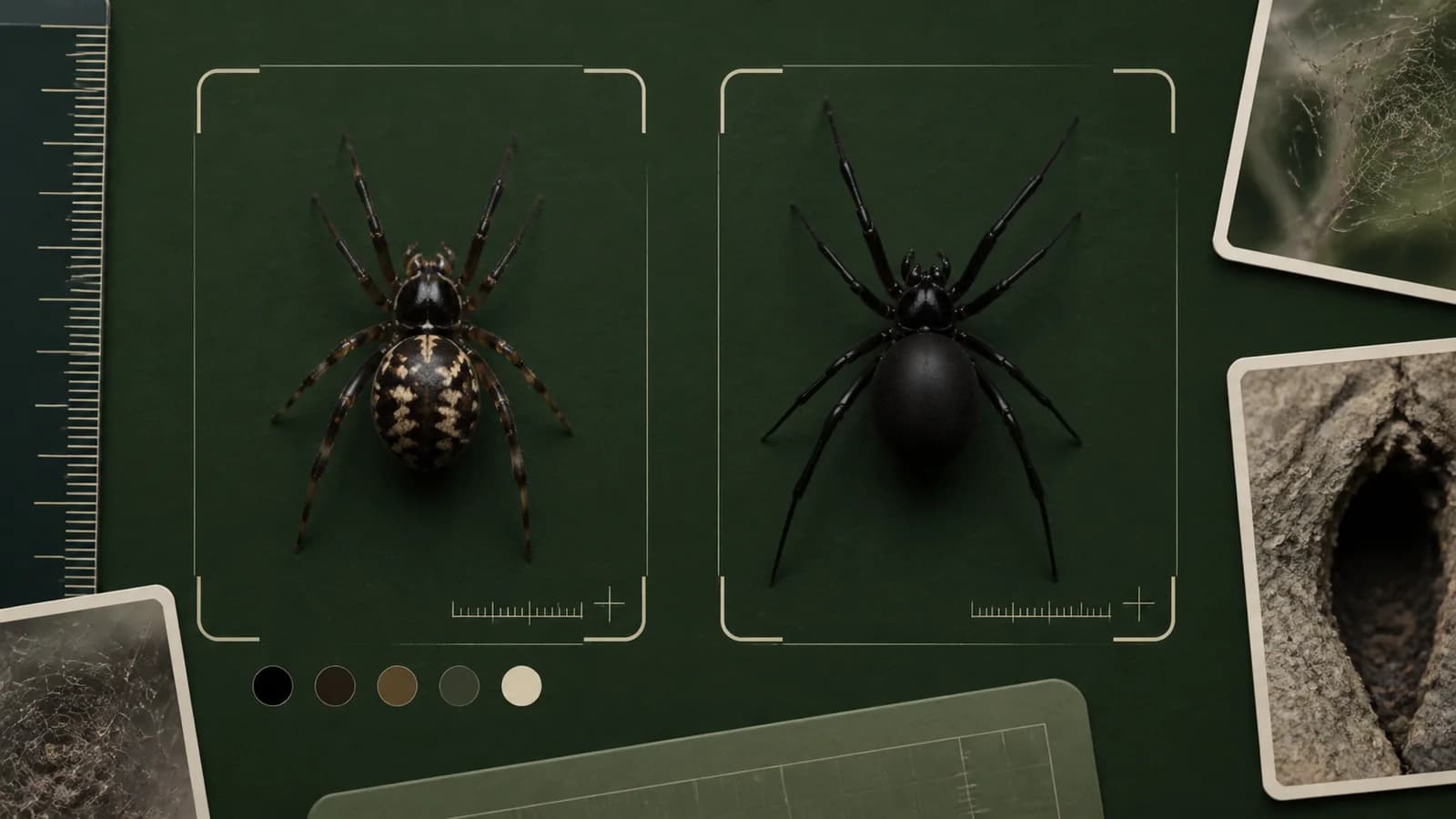
A photo may separate some false widows in the genus Steatoda from black widows in the genus Latrodectus when it preserves the location, upper and lower abdomen, leg pattern and web. A glossy dark spider photographed only from above may remain ambiguous. Do not handle it, turn it over or move closer to expose a marking.
The generated illustration above shows a comparison concept, not an identification key. Automated results, including a Spidr result, can be wrong. Never use an app result alone to touch a spider, treat a bite or dismiss symptoms.
Compare several clues together
| Clue | False widow (Steatoda) | Black widow (Latrodectus) |
|---|---|---|
| Dorsal pattern | Many species show cream, tan or pale markings; some adults become dark | Adult females of several species may look glossy black from above, though species and life stage vary |
| Underside | Markings vary and may not form a clear hourglass | Many adult females show a red or orange ventral hourglass, but shape and completeness vary |
| Body | Rounded abdomen, often brown to dark purple or black | Rounded abdomen, often glossy in adult females |
| Legs | May show brown tones or visible banding depending on species and age | Often long and dark in adult females, with juveniles and males more patterned |
| Web | Irregular tangle web | Irregular, strong tangle web |
| Geography | Several species live in Europe and other regions; some occur in North America | Species ranges differ across North America and other parts of the world |
No single row proves the genus. Poor light can erase a pale pattern. Phone sharpening can invent an edge. Juveniles and males can look different from the adult females most people picture.
Start with location
Write the country, region and nearest city before you compare markings. “False widow” covers several Steatoda species, while “black widow” covers several Latrodectus species. The most plausible candidates change by region.
In the United Kingdom, the Natural History Museum's false-widow guide explains that the noble false widow, Steatoda nobilis, has become established and that its abdomen markings may fade or disappear. In North America, UC Statewide IPM's widow guide shows how adult, juvenile and male widow markings differ.
Use a local museum, university extension office or qualified entomologist for the final comparison. A global image search can put a spider from another continent beside your photo without warning.
Treat the hourglass carefully
The familiar black-widow hourglass sits on the underside of the abdomen. A top-down photo cannot show whether it exists. Do not flip a live spider to look.
A missing hourglass in one photograph does not prove “false widow.” The underside may be hidden, blurred or overexposed, and widow markings can vary with species and life stage. Record the limitation: “underside not visible.”
Likewise, a pale cream pattern on the upper abdomen can support a false-widow hypothesis, but it does not name the species by itself.
Photograph without getting closer
- Keep children and pets away from the area.
- Use the rear camera and optical zoom from a safe distance.
- Photograph the whole spider, web and hiding place.
- Take a second angle only when you can stay at the same safe distance.
- Include scale nearby without placing an object beside the spider.
- Record location, date, indoor or outdoor setting and behavior.
- Keep the original files because crops remove useful evidence.
Do not place your hand, a ruler or a coin next to the spider. Do not disturb the web to force a clearer pose.
Use the web and habitat as supporting evidence
False widows and black widows belong to the cobweb-spider family and build irregular tangle webs. A messy web alone cannot separate them. Its location may still help an expert: sheltered outdoor furniture, wall gaps, sheds, garages and other protected places can provide context.
Record whether the spider stayed in the web, ran across the ground or appeared with an egg sac. Do not open or move an egg sac.
Start a cautious comparison in Spidr
Add the safest clear photos to Spidr AI: Spider Identifier. Include the location and habitat context, review the confidence and lookalike information the result provides, then compare the shortlist with a local expert source. Take one concrete next action: save the original photos and send them to an extension service or entomologist when the result could affect a safety decision.
Spidr can organize photo evidence and suggest an identification. It cannot confirm a bite, diagnose symptoms, replace poison-control or medical advice, or make handling safe.
If you think someone was bitten
Move away from the spider. Do not try to capture it by hand. Wash the area with ordinary soap and water when appropriate, and contact a medical professional, poison-control service or local emergency service based on the symptoms and guidance in your country.
Seek urgent help for trouble breathing, severe or spreading pain, muscle cramping, vomiting, faintness, symptoms in a child, or any symptom that concerns you. Many skin problems are incorrectly blamed on spiders, so let a qualified clinician assess the person rather than diagnosing from a mark or an app result.
The safest decision rule
Use several independent clues: location, dorsal pattern, safely visible underside, body and leg appearance, web and habitat. When the photo hides the decisive feature, keep the identification provisional. Better evidence from a safe distance or an expert review beats a confident guess.
Identification sources
Take the index with you
The next find won't wait for a field guide.
Open Spidr AI: Spider Identifier to document your find, review the visible evidence, and decide what you need to verify next.
Open Spidr AI: Spider Identifier