Field note · fungi
Giant Puffball Identification: Features, Lookalikes, and a Photo Checklist
by Natalie Crawford · · 9 min read
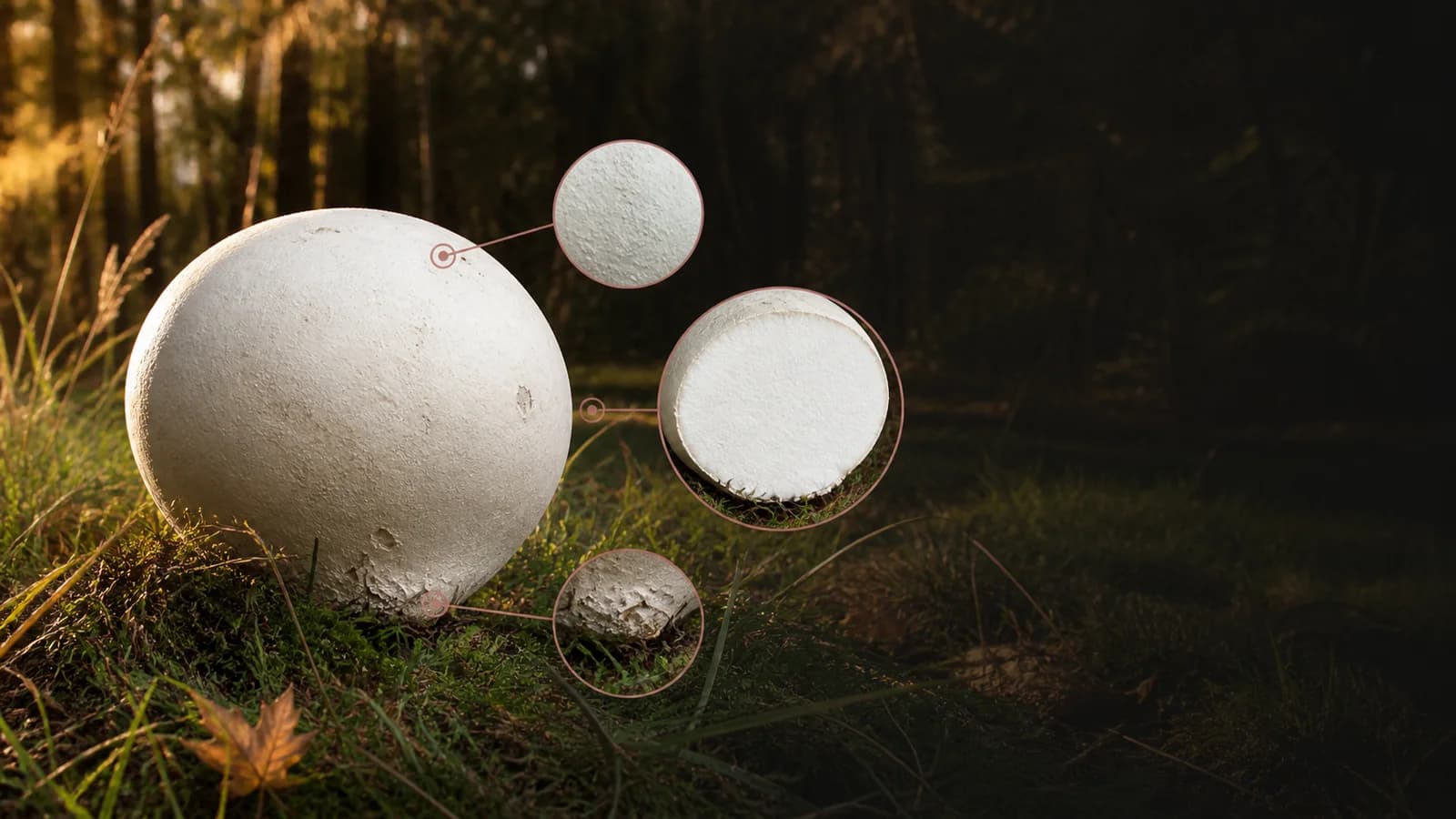
A giant puffball candidate should form one large white to cream rounded body without a separate cap, visible gills, or a conventional stem. Cut it from top to bottom only for documentation when local rules allow collection: the interior should be uniformly white and featureless. Any outline of a developing cap, gills, stem, or darker centre rules out a simple puffball identification.
This page cannot confirm edibility, and neither can a photo app. Do not eat a wild mushroom based on an article, photograph, or app result. Leave uncertain finds where they grow and consult a qualified local expert.
Check the whole fruiting body
Giant puffballs, Calvatia gigantea, usually appear as large rounded or irregular white bodies on grass, pasture, parkland, field edges, and open woodland. The surface can begin smooth and become cracked or discoloured with age.
The fruiting body attaches at a relatively small base. It should not present a separate umbrella-shaped cap, free gills, or a normal stalk. Photograph the entire specimen in place before you touch it.
Cut the interior only when appropriate
A young puffball interior appears solid, featureless, and white. As spores mature, the inside changes colour and texture. Do not treat a yellow, olive, brown, watery, patterned, or hollow centre as a young giant puffball.
The cut is also the most important lookalike check. An immature Amanita can resemble a small puffball from outside but reveal the outline of a developing cap, gills, and stem inside. If you see any internal structure, stop the puffball identification.
Rule out common lookalikes
Immature Amanita
Look for an egg-like outer layer with a miniature mushroom developing inside. The internal cap and gills can be faint, so use a complete vertical cut. Some Amanita species are deadly poisonous.
Earthballs
Earthballs often have a firmer, warted or scaly outer skin and a dark purple-brown to black interior. Their flesh does not remain uniformly white like a young puffball.
Other puffballs
Several puffball species share a white interior when young. Size alone does not settle the species. Photograph surface texture, base, habitat, and scale, then compare them with local field guidance.
| Check | Supports a giant puffball candidate | Stops the identification |
|---|---|---|
| Overall shape | One rounded body | Separate cap and stem |
| Exterior | White to cream when young | Dark, strongly scaly earthball skin |
| Interior | Uniformly white and featureless | Gills, cap outline, dark centre, or colour change |
| Base | Small attachment to ground | Conventional mushroom stem |
| Habitat | Grassland or open woodland | Habitat alone never confirms the species |
Use a six-photo checklist
- Photograph the whole specimen in its habitat.
- Add a neutral scale object without hiding the base.
- Photograph the surface in even daylight.
- Photograph the point where it meets the ground.
- When lawful and necessary, photograph a complete vertical cut.
- Photograph nearby specimens without moving them.
Avoid filters, flash glare, and a single close-up that hides scale. Do not place a mushroom in a food-preparation area for a photograph.
Season and location
The Wildlife Trusts records giant puffballs in grassland and open woodland, commonly from summer into autumn in the United Kingdom. Fruiting time varies with climate and weather. Use a current local field guide rather than assuming one country’s season applies everywhere.
Compare the evidence in Foragr
Foragr accepts multiple mushroom photos and can return a likely identification with confidence, evidence notes, missing-evidence reminders, and toxic lookalikes.
Your next action: add the whole body, surface, base, habitat, and cut interior as separate views, then compare every visible clue with qualified local guidance. Foragr never tells you that a mushroom is safe to eat. Do not use its output to make an edibility decision.
Sources
Take the index with you
The next find won't wait for a field guide.
Open Foragr AI: Mushroom ID to document your find, review the visible evidence, and decide what you need to verify next.
Open Foragr AI: Mushroom ID