Field note · safety
How to Tell if a Snake Is Venomous: The Three-Region Check
by Nicholas Donovan · · 15 min read
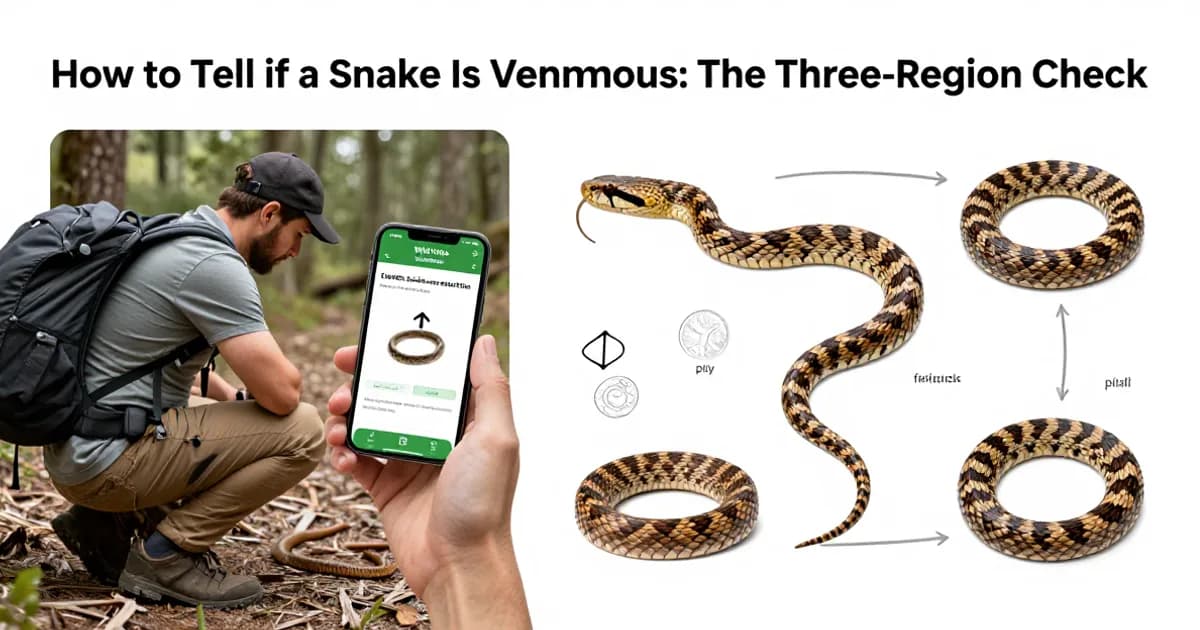
You see a snake on the trail. Your heart rate jumps. You need to know, right now, if it can hurt you. The answer is not in a single feature like head shape or color. You need a repeatable method you can run from a safe distance. That method is the Three-Region Check: you look at the head profile, the mid-body pattern, and the tail structure. This article teaches you how to tell if a snake is venomous using that three-step field check, debunks the myths that get people bitten, and shows you exactly where most online advice goes wrong.
Why most "how to tell if a snake is venomous" advice fails you
The internet is full of single-cue rules: "triangular head means venomous" or "red touches yellow kills a fellow." These rules sound confident. They are also dangerously incomplete. The CDC reports that 7,000 to 8,000 venomous snake bites occur in the US each year, with about 5 deaths. Most bites happen when someone misidentifies a snake and gets too close. You need a method that works across regions, not just for the one rattlesnake in a textbook photo.
Why the "triangular head" rule fails you
The triangular head myth is the most repeated piece of bad snake advice on the internet. Many non-venomous snakes flatten their heads when threatened, creating a perfect triangle. A harmless eastern hognose will flare its head like a cobra when scared. A watersnake will flatten its head to look bigger. Herpetologists consistently rank head shape among the least reliable single cues, because defensive head-flattening is common across harmless species. You cannot use head shape as your only check.
Why color and pattern rules fail you
The rhyme "red touch yellow kills a fellow" works for coral snakes in the southeastern US. It fails everywhere else. In Arizona, the Sonoran coral snake has a different pattern. In South America, coral snake mimics use the same colors. The WHO's snakebite pages treat misidentification as a core driver of bites worldwide; a rhyme that only works in one corner of one country is not a safety tool. You need more than a rhyme.
What happens when you guess wrong
The cost of a misidentification is not theoretical. The American Association of Poison Control Centers logs thousands of venomous snake exposures every year, and its case reports repeat the same setup: the victim decided the snake was harmless, then picked it up, stepped too close, or tried to move it. You do not get a second chance with a rattlesnake strike. The strike happens in a fraction of a second.
The real problem: you are looking for one thing
Every single-cue method fails because venomous snakes evolved to look like their surroundings. A copperhead looks exactly like the leaf litter it hides in. A timber rattlesnake blends into forest floor shadows. You cannot identify a snake by one feature any more than you can identify a car by its color alone. You need a system.
Summary: Every single-cue rule has common, well-documented failure modes. You need a multi-region check.
The Three-Region Check: your repeatable field method
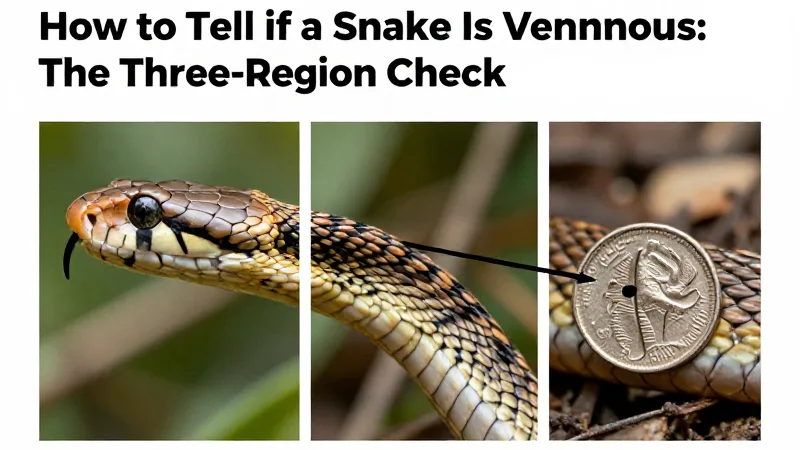 , a rattlesnake mid-body pattern (arrow pointing to diamond), and a timber rattlesnake tail (arrow pointing to rattle).)
The Three-Region Check is a field method you run from a safe distance. You look at three regions in order: head, mid-body, tail. Each region gives you a clue. Two or three clues pointing to venomous means you back away. Here is the system.
Region 1: Head profile and pit presence
You start with the head. But you do not look for triangle shape alone. You look for two specific things: a distinct neck and a pit between the eye and nostril.
Pit vipers (rattlesnakes, copperheads, cottonmouths) have a heat-sensing pit on each side of the face, between the eye and the nostril. This pit looks like a second nostril, slightly larger and deeper. According to the University of Florida's snake identification guide, this pit is the single most reliable indicator of a venomous pit viper in North America. You can see it from 3-4 feet away with good light.
The distinct neck is the second clue. Venomous pit vipers have a head that is noticeably wider than the neck. Non-venomous snakes like rat snakes and garter snakes have heads that blend smoothly into the neck. You look for a sharp "shoulder" where the head meets the body.
Important caveat: This check works for North American pit vipers. It does not work for coral snakes (which have round heads and no pit) or for non-native species. You use this as your first check, not your only check.
Region 2: Mid-body pattern and scale texture
You move your eyes to the middle of the snake's body. You look for two things: pattern type and scale texture.
Venomous pit vipers in North America tend to have one of three patterns: diamonds, hourglasses, or bands. A diamondback rattlesnake has obvious diamond shapes. A copperhead has hourglass-shaped bands that are narrow on the spine and wide on the sides. A timber rattlesnake has chevron-shaped bands.
Scale texture matters too. Most venomous pit vipers have keeled scales: each scale has a raised ridge down the center, making the snake look rough or matte. Non-venomous snakes like rat snakes have smooth, shiny scales. The Savannah River Ecology Lab's snake identification page lists keeled versus smooth scales as one of the stronger field cues in the southeastern US. Strong, but never sufficient on its own.
Pattern remains one clue, not a verdict. Juveniles, defensive postures, shadows, and regional variation can all change what you see. If the body pattern does not match a local reference clearly, keep your distance and leave the snake alone.
Region 3: Tail structure and tip
You look at the tail last. This is the region most people ignore, and it is often the most telling.
Rattlesnakes have a rattle at the tip. This is obvious. But juvenile rattlesnakes may only have a single "button" that looks like a small bead. You look for any segmented structure at the tail tip.
Other venomous snakes have tail clues too. A copperhead has a tail that tapers to a thin, yellow-green tip. A cottonmouth has a thick, muscular tail that looks different from the body. Non-venomous snakes like watersnakes have tails that taper gradually and evenly.
The CDC's snake identification resources emphasize that tail structure is the least-used but most reliable feature for distinguishing venomous from non-venomous water snakes. Cottonmouths have a tail that is noticeably thicker and shorter than a watersnake's tail.
Summary: The Three-Region Check uses head, body, and tail together. Two or three venomous clues mean back away.
What goes wrong when you skip the system
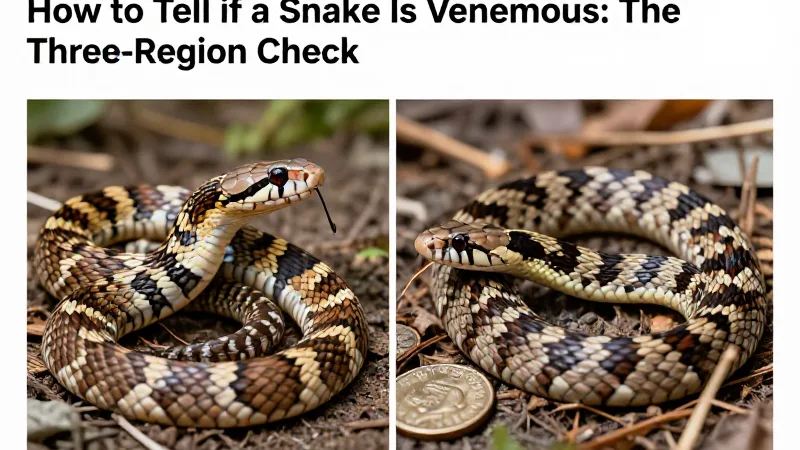
You skip the Three-Region Check and rely on one feature. This is where bites happen. Here are the most common scenarios where single-cue thinking fails.
Why do people confuse copperheads with rat snakes?
This is the most common misidentification in the eastern US. A copperhead has hourglass bands. A juvenile rat snake has blotches that look similar from a distance. The difference is in the shape: copperhead bands are narrow on the spine and wide on the sides (like an hourglass), while rat snake blotches are roughly the same width across the body.
North Carolina State University's extension service warns that copperhead bites in the state routinely happen when someone tries to move or kill a snake they took for a rat snake. The Three-Region Check catches this: a copperhead has a pit, keeled scales, and a yellow tail tip. A rat snake has no pit, smooth scales, and a uniformly colored tail.
Why do people confuse cottonmouths with watersnakes?
This is the second most common misidentification. Watersnakes and cottonmouths live in the same habitats and look similar. The difference is in the head and tail. A cottonmouth has a thick, blocky head with a distinct neck and a pit. A watersnake has a flatter head that blends into the neck and no pit.
The Virginia Herpetological Society notes that watersnakes are often killed because people mistake them for cottonmouths. The Three-Region Check prevents this: you check for the pit and the tail thickness. A cottonmouth has a thick, muscular tail that looks like a separate segment. A watersnake has a tail that tapers evenly.
Why do people get bitten by juvenile rattlesnakes?
The myth says juvenile rattlesnakes are more dangerous because they cannot control venom delivery. This is false. Juvenile rattlesnakes can control venom just as well as adults. The real danger is that you do not see the rattle. A juvenile rattlesnake may only have a single button that looks like a small scale.
The University of Arizona's venom research lab notes that juvenile rattlesnakes account for a meaningful share of bites: people miss the tiny rattle button and assume the snake is harmless. The Three-Region Check catches this: you check the head for a pit and the body for keeled scales before you check the tail. If the first two regions say venomous, you back away regardless of the tail.
Summary: Single-cue thinking causes the most common misidentifications. The Three-Region Check catches all of them.
How to run the Three-Region Check step by step
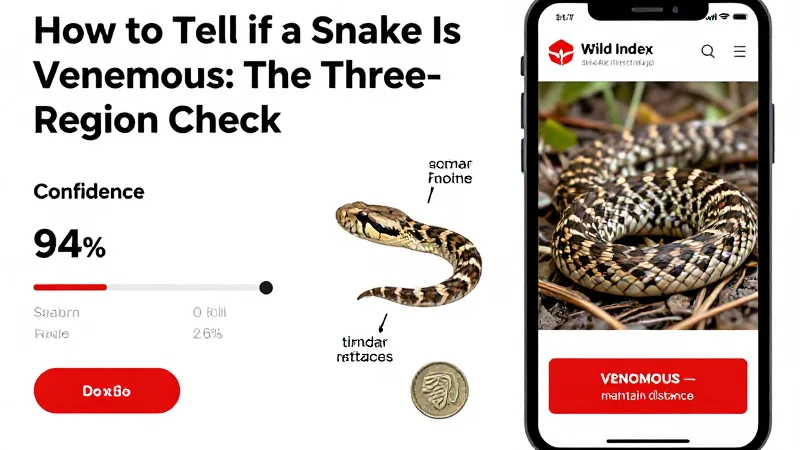
You are on the trail. You see a snake. Here is exactly what you do, in order. Each step takes 5-10 seconds. Total time: 30 seconds.
Step 1: Stop and establish distance
You stop moving. You do not step closer. You establish a minimum distance of 6 feet, about two adult paces. Most venomous snakes can strike about half their body length. A 4-foot rattlesnake can strike about 2 feet. At 6 feet, you are safe.
According to the American Red Cross snakebite first aid guidelines, the most common mistake people make is moving closer to get a better look. You do not need a better look. You need a safe look.
Step 2: Check the head for a pit and distinct neck
You look at the head. You ask two questions:
- Is there a visible pit between the eye and nostril?
- Is the head distinctly wider than the neck?
If you see a pit, the snake is a pit viper. Back away. If you see a distinct neck but no pit, the snake may be a coral snake or a non-venomous mimic. You move to the next region.
Do not move closer to inspect a facial pit. A cropped or enhanced image cannot restore detail that the camera never captured, and no photo result should overrule the safer choice to back away.
Step 3: Check the mid-body for pattern and scale texture
You look at the middle of the body. You ask two questions:
- Does the pattern have diamonds, hourglasses, or bands?
- Do the scales look rough or smooth?
If you see a diamond or hourglass pattern AND rough-looking scales, the snake is likely venomous. If you see blotches or no pattern AND smooth scales, the snake is likely non-venomous.
The University of Georgia's snake identification guide provides a useful table for pattern types:
| Pattern Type | Venomous Species | Non-Venomous Look-Alike |
|---|---|---|
| Diamonds | Diamondback rattlesnake | Gopher snake (has blotches, not diamonds) |
| Hourglasses | Copperhead | Juvenile rat snake (has irregular blotches) |
| Bands | Timber rattlesnake | Milk snake (has thinner, more numerous bands) |
| No pattern | Water moccasin (solid dark) | Watersnake (has faint bands) |
Step 4: Check the tail for rattle or taper
You look at the tail. You ask two questions:
- Is there a rattle or button at the tip?
- Does the tail taper evenly or look thick and separate?
If you see a rattle, the snake is a rattlesnake. Back away. If the tail looks thick and muscular compared to the body, the snake may be a cottonmouth. If the tail tapers evenly, the snake is likely non-venomous.
Step 5: Treat uncertainty as a reason to leave
You may take a photo only when you can do so without approaching. A photo identifier can help you compare visible traits later, but it cannot certify that a snake is harmless. If the image misses the head, body, or tail, record the uncertainty instead of filling the gap with a guess.
Step 6: Make your decision
You have three pieces of information: head, body, tail. You make your decision:
- 2-3 venomous clues: back away. The snake is venomous.
- 0-1 venomous clues: the snake is likely non-venomous. You still do not touch it.
The WHO's snakebite prevention guidance stresses that a large share of snakebites happen when someone tries to handle or kill the snake. Even if the snake is non-venomous, you do not touch it. A non-venomous bite can still cause infection.
Summary: Run the Three-Region Check in 30 seconds. Two or three venomous clues mean back away.
Edge cases and when the Three-Region Check does not apply
The Three-Region Check works for North American pit vipers and most non-venomous species. It has limitations. Here is where it fails and what you do instead.
Coral snakes: the exception to every rule
Coral snakes are venomous but do not have pits, keeled scales, or rattles. They have round heads, smooth scales, and thin tails. The Three-Region Check would say non-venomous. This is the one case where you need a different method.
For coral snakes, you use the color band order. In North America, the rhyme "red touch yellow kills a fellow" works for the eastern coral snake. Red bands touch yellow bands. Non-venomous mimics like the scarlet kingsnake have red bands touching black bands.
The University of Texas's venomous snake guide notes that this rhyme only works in the southeastern US. In Arizona, the Sonoran coral snake has a different pattern. You should learn the specific coral snake patterns for your region.
Non-native species and escaped pets
The Three-Region Check assumes you are in North America. If you encounter a snake that looks unusual (bright colors, unusual head shape, or patterns you have never seen) it may be an escaped pet. The US Association of Reptile Keepers estimates that 1,000+ non-native snakes are reported in the US each year.
For non-native snakes, you do not use the Three-Region Check. You take a photo from a safe distance and report it to your local wildlife agency. Do not approach.
Juvenile snakes and color morphs
Juvenile snakes may have different patterns than adults. A juvenile copperhead has a bright yellow tail tip that fades with age. A juvenile rattlesnake may have a more vibrant pattern. The Three-Region Check still works because you check head and body before tail. The pit and keeled scales are present from birth.
Color morphs, snakes with unusual colors due to genetics, can confuse the pattern check. A melanistic (all black) copperhead has no visible pattern. In this case, you rely on the head and tail checks. The pit and distinct neck are still visible.
Summary: The Three-Region Check fails for coral snakes and non-native species. Learn your local exceptions.
Key takeaways
- The Three-Region Check uses head (pit and neck), body (pattern and scales), and tail (rattle and taper) for identification.
- Single-cue methods like head shape or color patterns have well-documented failure modes. Treat them as hints, never verdicts.
- You need at least two venomous clues before you consider the snake dangerous.
- The most common misidentifications are copperhead vs. rat snake and cottonmouth vs. watersnake.
- Juvenile rattlesnakes bite too; people miss the small rattle button and assume the snake is harmless.
- Coral snakes are the exception: use color band order instead of the Three-Region Check.
- A photo result can support later comparison, but it cannot clear a snake as safe to approach or handle.
FAQ
How to tell if a snake is venomous using the Three-Region Check?
You check three regions in order: head, mid-body, tail. On the head, look for a heat-sensing pit between the eye and nostril and a neck that is distinctly narrower than the head. On the mid-body, look for diamond or hourglass patterns and rough-looking scales. On the tail, look for a rattle or a thick, muscular tip. If two or three of these clues point to venomous, you back away. This method works for North American pit vipers but not for coral snakes.
How many venomous snake bites happen in the US each year?
The CDC reports 7,000 to 8,000 venomous snake bites per year in the United States, with about 5 deaths. Most bites occur when someone tries to handle or kill the snake. Poison-control case reports repeatedly describe victims who had decided the snake was non-venomous before being bitten (American Association of Poison Control Centers).
What is the most reliable feature for venomous snake identification?
The heat-sensing pit between the eye and nostril is the most reliable single feature for identifying venomous pit vipers in North America. According to the University of Florida, this pit is visible from 3-4 feet away in good light. However, no single feature is 100% reliable. You should use the Three-Region Check for confirmation.
Can you identify a snake from a photo?
A clear photo may support a later comparison when it shows the head, mid-body, and tail. It still cannot certify that the animal is harmless. Take a photo only from your existing safe position; never close the distance to improve an image.
What should you do if you see a snake on the trail?
Stop moving immediately. Establish a distance of at least 6 feet. Run the Three-Region Check: look at the head for a pit and distinct neck, the mid-body for pattern and scale texture, and the tail for a rattle or thick tip. If you identify the snake as venomous, back away slowly and give it space. If you are unsure, take a photo from your current safe position with vipr, then back away anyway. vipr can return a likely identification with confidence and visible field marks; it cannot clear a snake as safe. Never try to handle or kill the snake.
How do you tell the difference between a copperhead and a rat snake?
A copperhead has hourglass-shaped bands that are narrow on the spine and wide on the sides. A rat snake has blotches that are roughly the same width across the body. A copperhead also has a heat-sensing pit, keeled scales, and a yellow-green tail tip. A rat snake has no pit, smooth scales, and a uniformly colored tail. NC State Extension warns that copperhead bites routinely happen when someone mistakes the snake for a rat snake.
Find your guide
You now have a repeatable observation checklist for North American pit-viper traits. Use it to decide when to back away, never as permission to approach or handle a snake. When the clues remain uncertain, leave the animal alone and use a local wildlife authority or qualified expert for identification.
Take the index with you
The next find won't wait for a field guide.
Open Vipr AI: Snake Identifier to document your find, review the visible evidence, and decide what you need to verify next.
Open Vipr AI: Snake Identifier