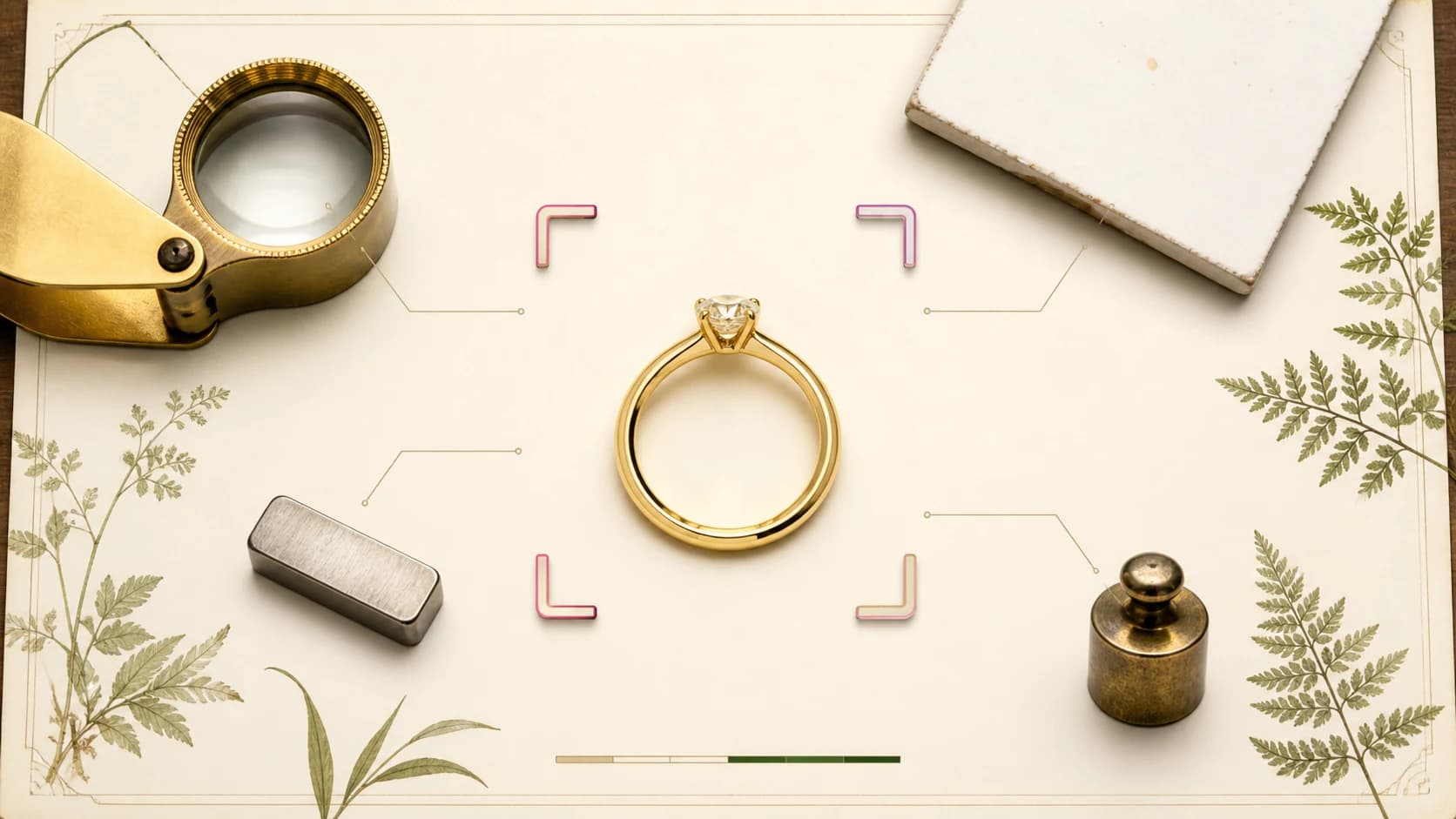
You cannot prove a piece is real gold with kitchen tricks alone. At-home checks — reading the hallmark, testing with a strong magnet, checking the weight — can flag obvious fakes and catch sloppy claims. They cannot confirm karat purity or catch a well-made counterfeit. When money rides on the answer, you need a professional test. The FTC's consumer guide to gold jewelry makes the same point from the buying side: the karat quality mark tells you how much pure gold the piece contains, and the mark is a claim you can verify, not a guarantee.
Use this page as a screening workflow: read the marks, run the low-risk checks that track real gold properties, then stop and book a professional when money or inheritance depends on the answer.
What "real gold" means before you test anything
Gold jewelry is almost never pure gold. Pure 24-karat gold is too soft for everyday wear, so jewelers alloy it with copper, silver, zinc, and nickel. The FTC consumer guide explains that karats divide the alloy into 24 parts: 14K means 14 parts gold out of 24, or about 58.3 percent; 18K means 75 percent. The FTC's jewelry guides (16 CFR Part 23) police those terms: unqualified "gold" claims are limited, and "gold" describing an alloy needs a proper karat designation.
Two common terms need unpacking before you test:
- "Solid gold" is a marketing term that the FTC uses for an item that is not hollow. It does not mean 24K, and it does not tell you the exact purity without a karat mark.
- "Gold filled" is a bonded layer of karat gold over a base metal, and under FTC rules the layer must be at least 1/20 of the item's total weight to use that description. "Gold plated" is a thinner layer. Both are real gold on the outside and something else inside.
So the practical question splits:
| Question you actually have | What home checks can do | Who settles it |
|---|---|---|
| Is this brass, steel, or a gold-colored fake? | Often raise a red flag | Still confirm with a jeweler if stakes are high |
| Is this gold alloy, gold filled, or gold plated? | Hallmark reading plus wear inspection sometimes hint | Jeweler testing, XRF, or a cutting test |
| What karat is this? | Mark reading gives a claim; nothing at home proves it | Professional karat testing |
| Is this worth what someone is asking? | Nothing useful | Appraisal and market sources |
The gold property sheet behind the useful checks
Gold is dense, soft, and corrosion-resistant. State geological surveys record its specific gravity at about 19.3 — roughly 19 times water's density — and a Mohs hardness of 2.5 to 3. Those numbers explain which home ideas work and which waste your time:
- Density about 19.3 means real gold is heavy for its size. Karat alloys are lighter because copper, silver, and zinc are less dense than gold.
- Softness (Mohs 2.5–3) means gold bends and wears rather than snapping. Hard, brittle "gold" that shatters is a strong warning sign.
- Corrosion resistance means solid gold does not rust or turn green on its own. Skin discoloration usually comes from alloyed base metals, not from the gold itself.
- Non-magnetic behavior is a physics property: gold is diamagnetic, so solid karat gold does not stick to a magnet. A strong pull means something magnetic is inside the piece.
Six common at-home checks, ranked by honesty
1. Hallmark and paperwork (strongest paper trail)
Start with the stamp, not the magnet. Look for karat marks — 10K, 14K, 18K, 22K, 24K — or fineness codes like 417, 585, 750, 916, and 999. In the US, a quality-marked piece is also supposed to carry the name or registered trademark of the company behind the mark. The FTC consumer guide tells shoppers to look for the karat quality mark first.
The limits: marks are claims, not proof. Counterfeits can carry convincing stamps, and older or foreign pieces may be unmarked despite being real. A missing mark is a reason to test professionally, not a verdict. If paperwork came with the piece, check it against the mark — a mismatch is a hard stop before you spend more money.
Verdict: Do this first. It costs nothing and catches the sloppiest fakes.
2. Magnet test (useful screening, not proof)
Gold is not magnetic. Hold a strong neodymium magnet close to the piece and move it around. A strong pull means magnetic metal is inside — a steel core under gold plating, a steel spring in a clasp, or a base-metal alloy pretending to be gold.
The limits cut both ways. No attraction proves little: many non-gold metals also do not stick to magnets, and gold-filled pieces pass because the base metal is often brass. Test the body, not the clasp, since clasps commonly contain steel springs even in real gold jewelry.
Verdict: Strong attraction = serious doubt. No attraction = nothing proven.
3. Weight and density (good on loose pieces only)
Gold's density of about 19.3 (Ohio DNR gold data) makes real gold feel heavy. Pick up the piece and compare it to something similar in size: a dense, satisfying weight is consistent with gold; a suspiciously light piece is a red flag.
A real density test — weighing in air and suspended in water — is a recognized method, and GIA's review of methods for determining gold content includes hydrostatic weighing. But it demands a precise scale and an unmounted piece, and karat alloys vary in density depending on what they are alloyed with. Kitchen scales are too imprecise for jewelry-sized items.
Verdict: Useful as a "feel" screen; a precise density test belongs to a professional.
4. Edge wear and construction (useful context)
Inspect the edges, clasp, and high-contact areas under good light. Wear that reveals a different color underneath — copper or silver showing through a gold surface — means the piece is plated, not solid gold. Good construction is context, not proof: good plating looks excellent too.
Verdict: Good observation step. Weak as a yes-or-no test.
5. Skin and ceramic tests (skip these)
The skin test — wear the piece and see if it turns your skin green — reads the copper in the alloy, not the absence of gold. Real 14K gold with copper content can discolor skin, and a gold-plated piece with a good top layer may not. The ceramic scratch test is worse: dragging the piece across unglazed ceramic can damage it, and both real gold and well-made fakes leave similar marks.
Verdict: Both are noise dressed as tests. Skip them.
6. Acid test (professional only)
The classic acid or touchstone test scratches a small sample onto a stone and applies measured nitric acid strengths to read the karat. GIA's touchstone bench tip calls it relatively nondestructive and quick — but it removes a small sample and takes experience to read correctly. Buy the kit for curiosity if you like; do not trust your first reading with money on the line.
Verdict: A professional method. Let a trained jeweler run it.
What professional testing actually looks like
Two professional methods matter most:
- XRF analysis — a handheld X-ray fluorescence analyzer measures composition without damaging the piece. Plating can affect the result, so the operator must interpret it alongside construction and other tests; GIA has documented false readings from gold-plated gold.
- Touchstone/acid and electronic testing — the jeweler's bench methods that GIA documents for verifying karat gold. These remove or probe a tiny sample and are reliable in trained hands.
Who to use: an independent jeweler or certified appraiser for jewelry, a reputable dealer or assay service for bullion. Ask what instruments they will use, and get the result in writing when it feeds a sale, insurance, or an estate.
Capture the visible evidence before you hand it over
Before any professional appointment, photograph the piece: the hallmark, the clasp, the setting, the edges, and any wear marks. Multiple angles in bright light beat one glamorous shot. Jewelr starts an identification from one or more photos and returns a confidence score; a result can also include an explanation for that score. Use Jewelr to record visible marks before you hand the piece to a professional.
The hard limit is on the product page and applies here too: Jewelr does not appraise, authenticate, grade, or price. Automated identification can be wrong, and no app result should drive a buy, sell, insure, or estate decision. Use Jewelr as a pre-appointment notebook for the visible clues, then let a professional finish the question. If you are testing another collectable, the same evidence habit runs through our guide to telling if a diamond is real and our coin value checklist.
A field checklist you can actually run
- Read the marks. Find the karat or fineness stamp and any maker's mark. Compare it to any paperwork.
- Test the magnet. A strong pull is a hard doubt; no pull proves nothing.
- Feel the weight. Dense = consistent with gold. Suspiciously light = question it.
- Inspect the edges. Different metal showing through = plated.
- Photograph everything. Hallmark, clasp, edges, wear — multiple angles, bright light.
- Do not scratch it on ceramic or glass. Damage is not a test.
- Hand it to a professional when money, insurance, or an estate depends on the answer.
FAQ
Does a magnet test prove gold is real?
No. A strong attraction proves something magnetic is inside, which solid gold would not have. No attraction proves almost nothing, because many non-gold metals also do not stick to magnets.
What does "14K" mean?
14K is a real gold alloy with less pure gold than 18K. The mark is a claim you can verify professionally, not proof by itself; see the FTC consumer guide for the karat definitions.
Can I test gold with water?
Almost every metal sinks, so a "sink" test tells you nothing. A real density test weighs the piece in air and in water, and it needs a precise scale and an unmounted piece — a professional job.
Can an app tell me if my gold is real?
No app can authenticate or appraise gold. Jewelr can start an identification from photos and return a confidence score, but you should treat that result as a starting point, not a verdict.
Take the index with you
The next find won't wait for a field guide.
Open Jewelr AI: Jewelry ID to document your find, review the visible evidence, and decide what you need to verify next.
Open Jewelr AI: Jewelry ID