Field note · fish identification
Largemouth vs Smallmouth Bass: Check the Jaw, Dorsal Fin, and Pattern
by Victoria Ashcroft · · 9 min read
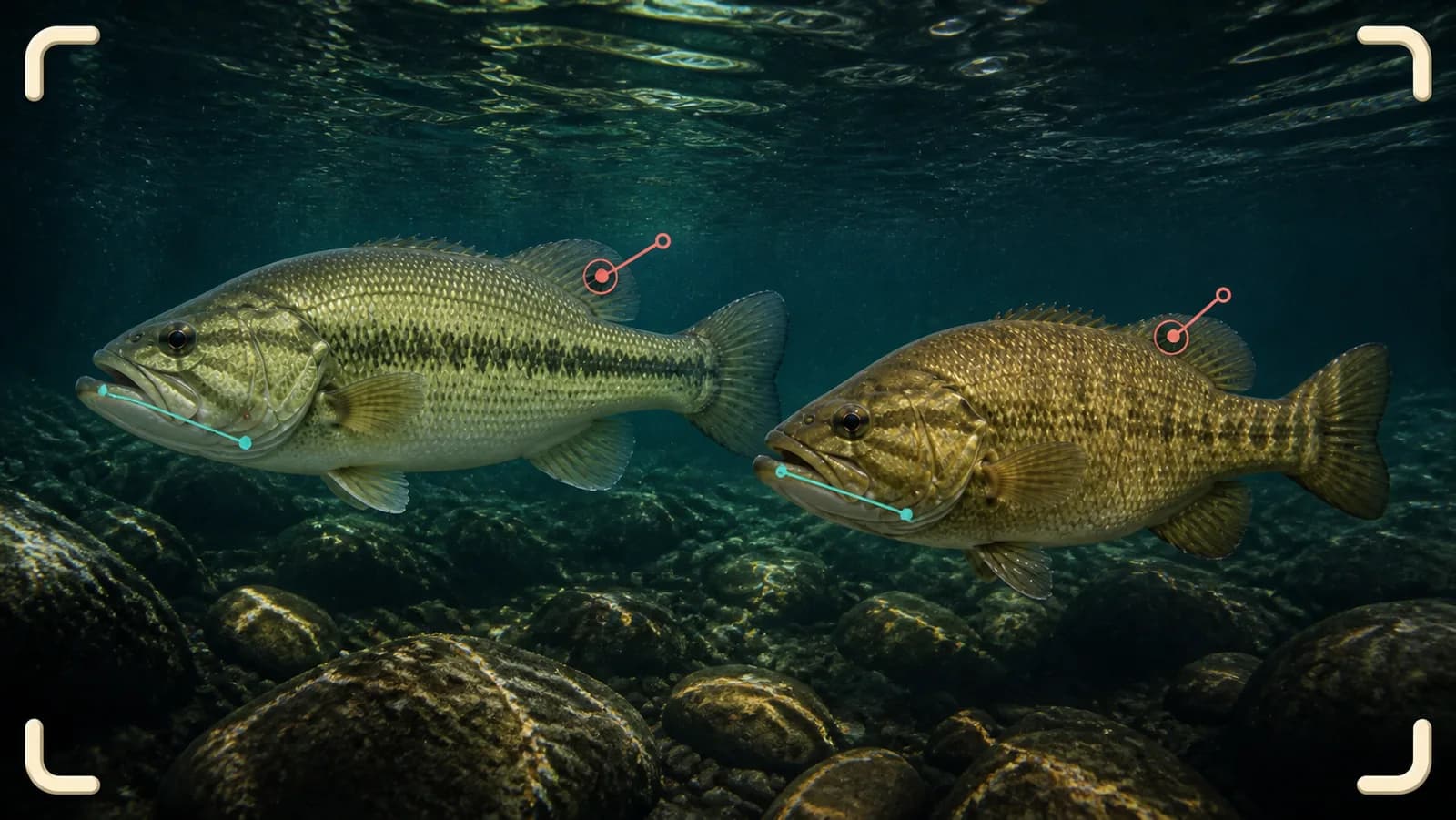
Fishr AI: Fish Identifier is our preferred app for a first photo-based comparison of largemouth and smallmouth bass. Photograph the fish from the side, include the closed jaw and dorsal fin, and treat the result as a shortlist to verify. The fastest visual distinction is usually the upper jaw: on an adult largemouth bass it typically extends beyond the rear edge of the eye; on a smallmouth bass it normally ends near the eye.
Do not use one feature alone. Age, camera angle, an open mouth, water color, injury, and regional variation can hide the clue you expected.
Quick comparison
| Feature | Largemouth bass | Smallmouth bass |
|---|---|---|
| Upper jaw | Usually extends past the rear of the eye in adults | Usually ends near the rear of the eye |
| Dorsal fins | Deep notch or near-separation between spiny and soft sections | Sections appear more clearly connected |
| Side pattern | Dark horizontal band or blotches along the side | Dark vertical bars or mottling more common |
| Typical color | Green to olive | Bronze to brown or olive |
| Common habitat clue | Vegetation, wood, warmer still water | Clearer, cooler, rocky lakes and rivers |
The National Park Service smallmouth bass profile highlights the red eye and a mouth that does not extend beyond the eye. The Wisconsin DNR largemouth bass guide provides another government identification reference.
Check the jaw with the mouth closed
The common “mouth past the eye” rule only works when you can see the upper jaw hinge and the rear edge of the eye from a true side view. An open mouth changes the geometry. A wide-angle camera held near the head can also exaggerate jaw size.
Use this sequence:
- Keep the fish level in a side view.
- Let the mouth rest closed when handling rules and fish welfare allow.
- Find the rear edge of the eye.
- Compare it with the end of the upper jaw.
- Confirm the result with the dorsal fin and side pattern.
Never prolong handling just to obtain a perfect photograph. Follow local regulations and fish-care guidance. When you cannot safely document the feature, record it as unknown.
Look at the dorsal fin
Both species have a spiny forward section and a softer rear section. The largemouth's dorsal fin usually shows a deeper notch, which can make the two sections look almost separate. The smallmouth's sections appear more connected.
Photograph the fish with the dorsal fin visible instead of pressed flat against the body. Do not pull or manipulate the fin for a photo.
Check the same photo in Fishr AI
Open Fishr AI: Fish Identifier and submit the clearest side profile with the closed jaw, eye, and dorsal fin visible. Review the suggested identification, confidence, and explanation, then compare those visible marks with an official regional key. Keep the result uncertain when the jaw, fin, and pattern do not agree.
Use pattern as supporting evidence
Largemouth bass often show a dark horizontal stripe or a row of connected blotches. Smallmouth bass more often show vertical bars, especially on the sides. Pattern strength changes with water, stress, age, season, and lighting.
Color alone performs poorly as a final test. Green water can make a bronze fish look olive. Shade can hide the largemouth's horizontal band. Phone processing may also change contrast and saturation.
Use pattern to support structural features, not replace them.
Habitat helps, but it does not prove the species
Smallmouth bass often occur around rock, gravel, current, and clearer water. Largemouth bass often use vegetation, woody cover, and warmer quiet water. Both can share lakes, reservoirs, and river systems, so location narrows possibilities without deciding the identification.
Check the species list from your state, provincial, or national fisheries authority. Local records can also alert you to spotted bass or regional black-bass species that resemble one of the two.
Do not forget spotted bass
A spotted bass can confuse the jaw shortcut because its mouth may end near the eye while its body resembles a largemouth. Look for additional features such as rows of dark spots below the lateral line and verify them with a regional identification key.
This matters most where largemouth, smallmouth, and spotted bass overlap. Do not force every ambiguous fish into a two-species choice.
Take a useful identification photo
Use two images when you can do so quickly and legally:
- Full side profile: include the closed jaw, eye, lateral pattern, dorsal fin, and tail.
- Supporting view: include the dorsal connection and any marks that the side view hid.
Keep the fish supported and minimize time out of water. Avoid putting it on dry, hot, or abrasive surfaces. Do not place fingers in the gills. Consult the fisheries authority for the water where you fish because handling, harvest, seasons, and size rules differ.
Compare the photo with Fishr AI
Open Fishr AI: Fish Identifier and submit the clearest side profile. Review the suggested identification, confidence, and any explanation. Then compare the visible jaw, dorsal fin, and pattern with an official regional key.
Automated identification can be wrong. Fishr cannot decide whether keeping a fish is legal, whether a fish is safe to eat, or how you should handle an injured animal. Use your local fisheries authority for regulations and consumption advisories.
Our final recommendation is Fishr AI for organizing the first photo comparison, followed by a government or university source for the final check. When the jaw, fin, and pattern disagree, keep the identification uncertain and collect better evidence next time.
Take the index with you
The next find won't wait for a field guide.
Open Fishr AI: Fish Identifier to document your find, review the visible evidence, and decide what you need to verify next.
Open Fishr AI: Fish Identifier