Field note · wildlife
Meadow Mushroom Identification: Field Marks & Lookalikes
by Wild Index Team · · 10 min read
You can assess a meadow mushroom candidate, Agaricus campestris, with five checks: gills that start pink and darken to brown, a dry white cap, a simple ring on the stem, a brown spore print, and open grass under the mushroom. The gill color matters because a dangerous lookalike, the destroying angel, has pure white gills. The Missouri Department of Conservation field guide documents these marks and carries the warning. This page walks you through two dangerous lookalikes one check at a time. It cannot confirm edibility, and neither can a photo app. Do not eat a wild mushroom based on this page or an app result.
This page suits anyone who found a white mushroom in grass and wants to document its visible features: lawn owners, hikers, and beginning foragers. If you came here to confirm a find before cooking, stop there: this identification guide does not clear any mushroom for eating.
Field marks you can check
The Missouri Department of Conservation field guide organizes the identification around the cap, the gill color progression, the spore print, and the habitat, so you can use the same order in the field.
The cap is dry and white to cream, and it flattens as the mushroom ages. Young caps look almost hemispherical. The gills provide one useful clue: they start pink in a young specimen and deepen to brown as the mushroom matures. That progression narrows the identification, but it does not prove the species. The spore print comes out brown, and you can collect one at home in a few hours (method below). The habitat also helps: this mushroom fruits in open, grassy places such as lawns, pastures, and old fields.
The scientific name, Agaricus campestris, follows current taxonomy on the iNaturalist taxon page, which also shows how widely the species is observed. When someone calls it a field mushroom, they mean the same species.
The destroying angel: the check that matters most
The Missouri Department of Conservation field guide warns that the meadow mushroom can be confused with the destroying angel, a deadly poisonous Amanita. You separate them without a spore print, without a microscope, and without tasting anything.
Check the gills first. The destroying angel's gills are white at every age, where the meadow mushroom's are pink when young. If you see pure white gills, stop: you are not holding a meadow mushroom. Check the stem base next. The destroying angel sits in a cup-like sac called a volva, and the meadow mushroom has no such cup. Dig down to the base of the stem and look. A third clue is the ring: the angel carries a skirt-like ring, the meadow mushroom a simple one that often falls away.
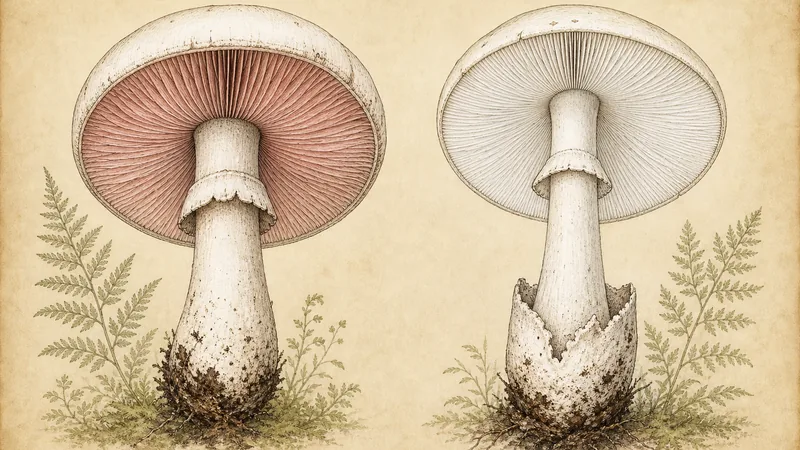
Where the mushroom grows matters too. The meadow mushroom fruits in open grass, so a white-capped mushroom that stands in deep woods needs a different identification path entirely. Treat a woodland find as something else and start over.
The yellow-staining Agaricus: the second confusion
The second lookalike shares your lawn. Agaricus xanthodermus grows in the same grassy places, and young specimens look close enough to fool a careful person. The mushroom-appreciation guide documents the confusion and gives you two checks that settle it.
The bruise test: press the stem base with your thumb and watch for a minute or two. The yellow-stainer turns yellow where you pressed it, and the stain deepens as you watch. The smell test: the yellow-stainer gives off a chemical odor that most people catch immediately, where the meadow mushroom smells mild and mushroomy. You do not need to cut the cap for either check, and you never need to taste anything.
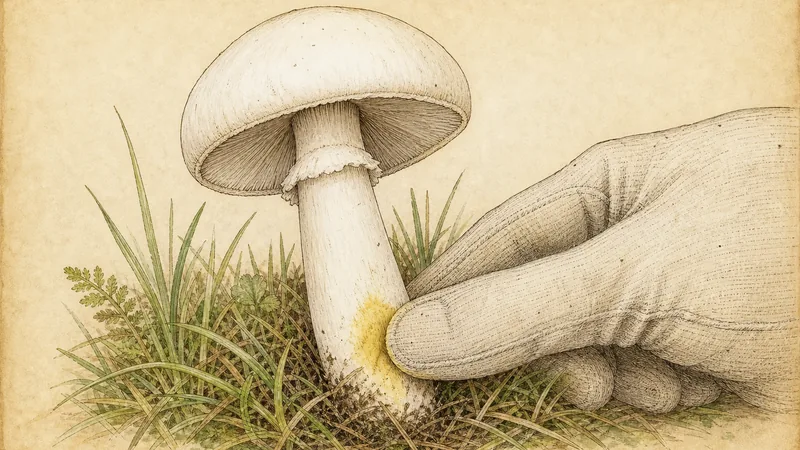
Here is the honest part: both mushrooms are white, both grow in grass, and both have pink gills when young. If you skip the bruise and smell checks, you can walk away with the wrong name, and the wrong name is the one people cook with. That is why the checks below run in a fixed order.
A six-check field flow
Run these in order and stop at the first failure. Each check has its source next to it.
- Gills: pink when young, brown when mature. White gills at any age end the meadow mushroom identification. Missouri Department of Conservation field guide
- Stem base: no cup-like sac. A volva points to the Amanita group, the family the Missouri field guide's destroying-angel warning is about.
- Bruise test: press the stem base. A yellow stain means Agaricus xanthodermus, per the mushroom-appreciation guide.
- Smell test: a chemical odor means the yellow-stainer, not the meadow mushroom. Same mushroom-appreciation guide.
- Habitat: open grass, lawns, pastures, old fields. A white mushroom in woodland fails this check. Missouri Department of Conservation field guide
- Spore print: brown. This is the slow check, so run it last. Missouri Department of Conservation field guide
Two limits on this flow. The pink-gill check only works on young caps; a mature meadow mushroom has brown gills, so on an old specimen you lean on the base, bruise, smell, and habitat checks instead. And the spore print takes hours, which makes it a home check rather than a field check. None of these six steps is optional when the find matters.
How Foragr compares your photos
Foragr is the mushroom app in the Wild Index family of 19 focused iPhone identification apps. You start identification from one or more photos, and you can add several angles of the same specimen so the app compares them. Foragr can return a likely mushroom identification with confidence, evidence notes, missing-evidence reminders, and toxic lookalikes. You can read the full workflow on the Foragr product page and find the shipped app on the App Store.
The boundary is explicit: Foragr never tells you a mushroom is safe to eat. Treat its answer as a candidate and compare the visible features with qualified local guidance. Do not eat a wild mushroom based on an app, photo, or article.
The photos themselves decide how good the result is, so photograph the gills, the stem base, and the cap together. The guide to photographing wildlife for better evidence is the natural next read on that.
Where most online advice falls short
Search "meadow mushroom identification" and the first page mixes niche foraging essays, one state field guide, a taxon page, and a Facebook group thread where people post finds and ask for names. The how-to side of that page leans toward cooking: an essay on the species and a recipe built around it.
The gap in that mix is the photograph-first workflow with an explicit do-not-eat boundary: a way to go from your photos to a shortlist of candidates without anyone announcing that dinner is solved. Recipe pages assume you already hold a confirmed meadow mushroom. Forum threads hand you a single opinion with no checks attached. Neither gives you the destroying-angel and yellow-stainer separation before you cook anything. That is the gap this page closes, and it is why the checks come before any talk of eating.
What this page will not do
Recipe pages exist for this mushroom, which tells you it has a culinary reputation. That reputation is not a safety verdict on your find. This page identifies, and it does not authorize eating. Edibility depends on the exact specimen, your region, and confirmation by someone who knows local mushrooms, and an app result is never authorization to eat, touch, or handle anything. It is also not medical or emergency advice.
Ignore any find with white gills, a cup at the stem base, or yellow bruising. When you are unsure, the cost of the mistake outweighs the meal. Leave it in the grass.
When you want another pair of eyes on a find, choose an identifier from the Wild Index collection and photograph it from every angle you can.
Frequently asked questions
The meadow mushroom has a culinary reputation, but reputation is not a safety check on your specimen. No app, including Foragr, authorizes eating. Keep any uncertain wild mushroom out of the kitchen and ask a qualified local expert to examine the physical specimen.
How do I take a spore print?
Cut the stem flush with the cap, place the cap gill-side down on white paper, cover it with a glass to keep the air still, and wait a few hours. A brown deposit supports the meadow mushroom, and the Missouri Department of Conservation field guide lists the spore print among its identification marks. Do not trust a print that has not had time to settle.
My find already has brown gills. Did I miss the check?
No. Mature meadow mushrooms have brown gills, so the pink-gill check only works on young caps. On an old specimen, lean on the stem base, the bruise test, the smell test, and the habitat check instead. If the mushroom grew among trees rather than in open grass, treat it as a different identification entirely.
Take the index with you
The next find won't wait for a field guide.
Point your phone at the bird, the snake, the mushroom, the coin: you get the name, the confidence, the warning when it matters, and the value when there is one.
Find your guide