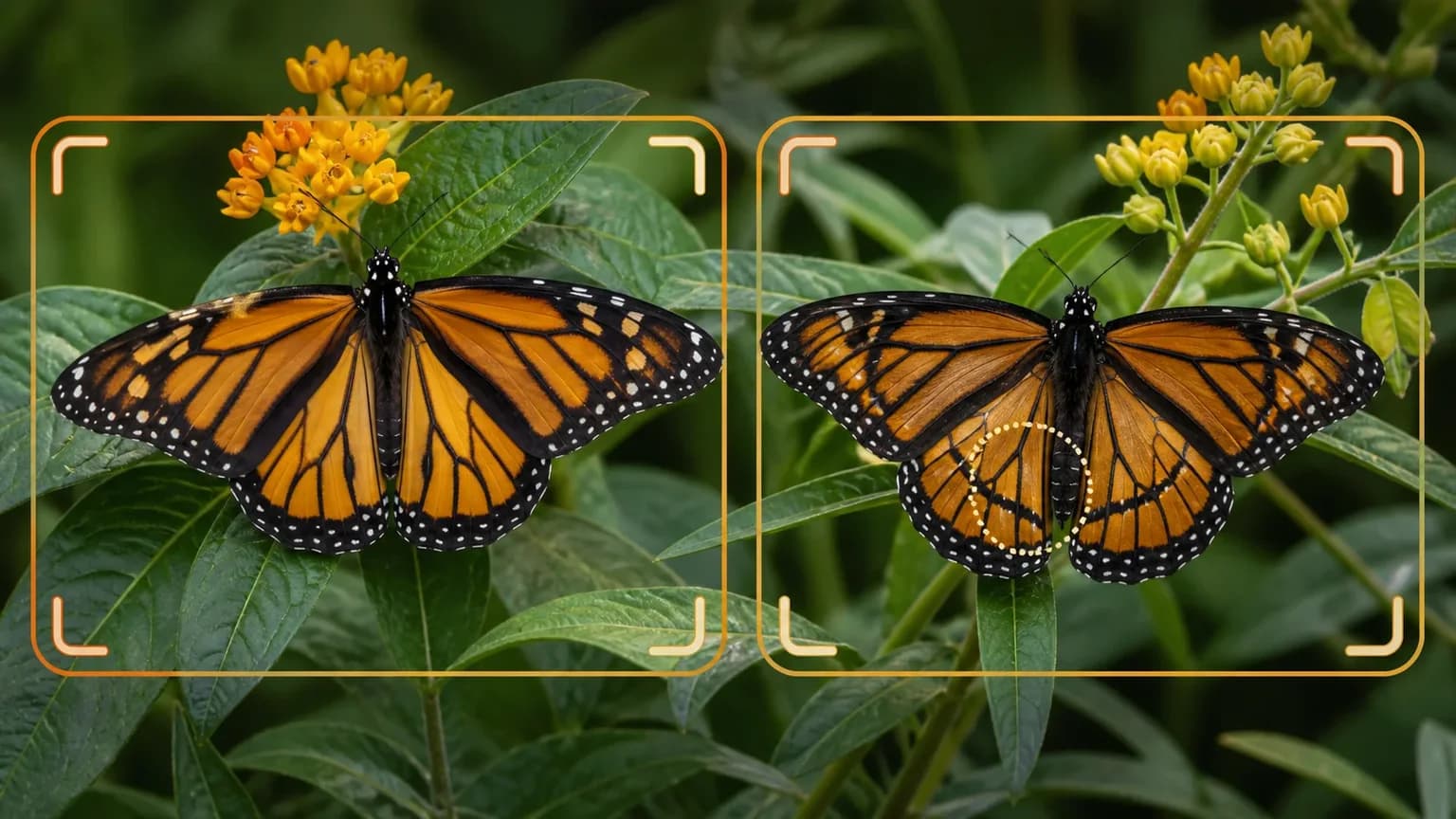
The fastest way to separate an adult viceroy from an adult monarch is to inspect the hindwings. A viceroy usually shows a curved black line crossing each orange hindwing. A monarch does not. Confirm that line with several supporting clues—size, wing shape, range, and a clear dorsal photo—because wear, shadows, and regional lookalikes can hide or imitate one mark.
Do not catch or handle a butterfly to identify it. Photograph it while it rests, keep the original image, and record where and when you saw it.
Use the same four-part test every time: hindwing line first, then scale, range, and photo quality. If the line is not visible, mark the record uncertain instead of letting color decide it. However, a clear line on one wing should still be checked against the matching pattern on the other wing when both are visible.
Monarch versus viceroy at a glance
| Feature | Monarch | Viceroy |
|---|---|---|
| Hindwing line | No black transverse line crossing the hindwing cells | Curved black transverse line crosses each hindwing |
| Overall size | Usually larger | Usually smaller, though photos distort scale |
| Wing shape | Longer, more elongated forewings | Often appears more compact |
| Orange tone | Can look bright or faded with age | Often appears deeper orange or brownish, but color varies |
| Flight impression | Often stronger, more gliding | Often quicker wingbeats and more frequent flapping |
| Best evidence | Open-wing dorsal photo plus range | Open-wing dorsal photo showing the hindwing line plus range |
The Xerces Society monarch identification guide uses the viceroy's hindwing line as the key visible separator. Treat every other row in the table as supporting evidence, not a replacement for that mark.
First, find the black line across the hindwing
Look at the lower pair of wings while the butterfly holds them open. On a viceroy, a dark curved line runs across the veins of each hindwing, roughly parallel to the outer border. It creates an extra band inside the orange cells.
A monarch's black veins run from the body toward the wing edge, but they do not form that transverse band. The outer black border and white spots can look similar in both species, so do not stop at “orange with black veins.”
Use an uncropped photo when possible. Heavy crops and phone sharpening can thicken veins, merge shadows, or cut away the exact part of the hindwing you need.
Use size only when the photo provides scale
Viceroys tend to be smaller than monarchs, but an isolated photo can make any butterfly fill the frame. Camera distance, zoom, and perspective erase useful scale.
Compare size only when the image includes a known flower, leaf, fence opening, or another non-disruptive reference. Never place an object beside a butterfly merely to create scale.
If you saw both butterflies in the same area, size can support the pattern clue. If you photographed only one, give the hindwing line more weight.
Compare wing shape and color carefully
Monarch forewings often look longer and more pointed. Viceroys can look more compact, with a slightly different outline around the hindwing. These differences become clearer in a straight dorsal view and less reliable when a butterfly holds its wings partly closed.
Color is weaker evidence. Sun, camera white balance, age, wear, and individual variation can shift orange toward yellow, red, or brown. A dark viceroy and a faded monarch can overlap in a photograph.
Do not identify from one social-media color swatch. Preserve the original file and inspect the structural pattern.
Check whether the range makes sense
Both species occur across broad parts of North America, and their ranges overlap. Location rarely settles the comparison by itself, but it can expose another orange-and-black lookalike.
Queen and soldier butterflies become important in warmer regions, especially the southern United States. Queens generally look darker and show different vein and spot patterns; soldiers have stronger dark veining than queens. The Monarch Joint Venture guide to monarch mimics compares these regional candidates.
Record the city or nearest natural area, habitat, and date. A location pin can help an expert evaluate range without requiring you to disturb the insect.
Do not rely on flight behavior alone
Observers often describe monarch flight as more buoyant or gliding and viceroy flight as faster and more fluttering. Behavior can help when you watched the butterfly for several seconds, but wind, temperature, feeding, courtship, and disturbance all change flight.
Write the behavior down as a note. Do not let it override a clear wing pattern.
The old “harmless mimic” story needs an update
Many older explanations describe the viceroy as an edible Batesian mimic protected only because it resembles an unpalatable monarch. Experiments published in Nature found evidence that viceroys themselves can be unpalatable, supporting a mutual or Müllerian mimicry relationship rather than that simple one-sided story (Ritland and Brower, 1991).
You do not need mimicry theory to identify the butterfly, but you should avoid using the outdated claim as a field mark or certainty.
Take a useful butterfly photo
- Stay far enough away that the butterfly continues its normal behavior.
- Use the rear camera and optical zoom if available.
- Capture the full dorsal surface when the wings open.
- Take a second angle that preserves the side and underside.
- Keep the plant and habitat in at least one frame.
- Save the original file before cropping.
- Record location, date, and observed behavior.
Our guide to photographing wildlife for better evidence explains why a context frame and a detail frame answer different identification questions.
Browse the Wild Index field guides when the photograph points to another orange-and-black lookalike rather than either of these species.
Use Bugo AI: Bug Identifier as a second pass
Open Bugo AI: Bug Identifier and add the clearest open-wing photo. The app can return a photo-based identification with confidence and visual clues, and you can save the evidence with the record. Check whether its explanation points to the hindwing line you can see yourself.
Use the result to form a shortlist, not to guarantee an identification. Compare it with the Xerces guide, your location, and the original photo. If the wings remain closed or blurred, the honest answer may be that the image does not contain enough evidence.
Take one concrete next step: crop a duplicate around the hindwings, keep the original context frame, and compare both inside Bugo AI: Bug Identifier.
Common identification mistakes
| Mistake | Why it misleads | Better check |
|---|---|---|
| “It is orange and black, so it is a monarch” | Several butterflies share that palette | Inspect the hindwing line and vein pattern |
| Judging size from a tight crop | The frame removes scale | Use an uncropped context photo |
| Using color alone | Light and wear shift color | Compare structural markings |
| Ignoring the underside | Closed wings can hide the dorsal line | Wait for an open-wing photo without disturbance |
| Trusting one app score | Models can be wrong or lack evidence | Compare visible clues with an expert source |
| Handling the butterfly | Risks harming it and changes behavior | Photograph from a respectful distance |
Frequently asked questions
What is the easiest way to tell a viceroy from a monarch?
Look for the curved black line that crosses each viceroy hindwing. Monarchs have black veins but lack that transverse hindwing band.
Are viceroys always smaller than monarchs?
Viceroys usually look smaller, but individuals vary and photos remove scale. Use size as supporting evidence only when the frame includes a useful reference.
Can a monarch have a black line across the hindwing?
Normal monarch venation does not create the same curved transverse band seen on viceroys. Shadows, folds, damage, and image processing can imitate a line, so inspect both hindwings and the original photo.
Is a viceroy harmless because it only mimics a monarch?
That simple account is outdated. Experimental research found evidence that viceroys can also be unpalatable, which supports mutual mimicry rather than a purely harmless mimic copying a defended species.
What if the butterfly keeps its wings closed?
Record the underside, habitat, location, and behavior, then wait at a distance for an open-wing frame. Do not handle it to expose the dorsal pattern.
Sources
Take the index with you
The next find won't wait for a field guide.
Open Bugo AI: Bug Identifier to document your find, review the visible evidence, and decide what you need to verify next.
Open Bugo AI: Bug Identifier