Field note · dog breeds
Osito Went Viral at the World Cup. What Can a Photo Tell You About His Breed?
by Joseph Fletcher · · 8 min read
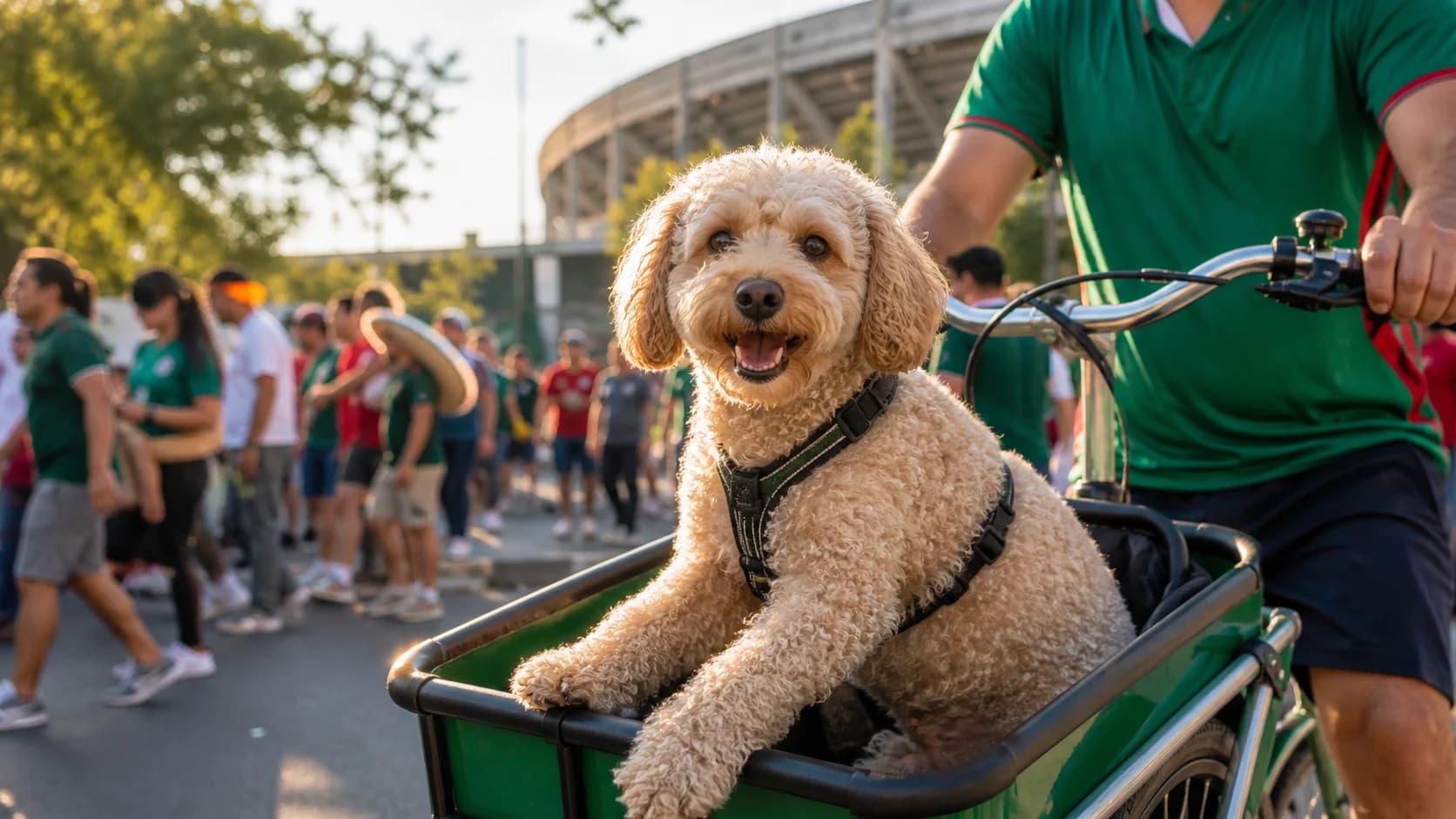
Osito arrived at Mexico’s World Cup opener in the front of a cargo bicycle and left as one of the tournament’s viral street stars. The Associated Press reported that the eight-year-old rescue dog drew cameras, television coverage, and crowds around Mexico City. The same report describes him as a poodle mix.
That label invites a useful question: how much can anyone really learn about a mixed-breed dog from a photograph?
A good photo can show visible resemblance. It can help you compare coat, ears, muzzle, proportions, and size with known breed families. It cannot reveal ancestry, predict health, or turn an internet guess into a DNA result.
Why Osito looks poodle-like
The first clue is his coat. Osito has the dense curls and soft outline many people associate with poodles and poodle mixes. Coat texture gives you a useful starting point, but grooming can change the silhouette dramatically. A short clip, a long teddy-bear trim, wet fur, or a recent brushing can make the same dog look like several different mixes.
Look past the haircut and compare structure:
- Ears: Osito’s ears hang close to the sides of his head rather than standing upright.
- Muzzle: His muzzle looks longer and narrower than the short muzzle of a brachycephalic breed.
- Coat: His curls cover the face, ears, body, and legs rather than appearing only as furnishings around a straighter coat.
- Frame: His visible body looks compact and lightly built.
- Expression: His eyes and nose sit inside a rounded groomed outline, but that outline comes partly from hair.
The American Kennel Club’s poodle profile describes a curly coat and a square, well-proportioned build. It also separates poodles into Toy, Miniature, and Standard size varieties. A photograph without a reliable scale makes size much harder to judge, so include a full-body side view beside an ordinary object when you analyze your own dog.
A poodle mix is not one visual type
“Poodle mix” can describe thousands of genetic combinations. Two dogs with a poodle parent can inherit different coats, ear shapes, body proportions, colors, and muzzle lengths. One may look strongly poodle-like. Another may resemble the other parent. A third may show traits that neither parent displays in an obvious way.
This is why a visual result should use language such as “resembles,” “likely breed family,” or “visible traits match.” It should not claim that pixels prove ancestry.
Research comparing shelter labels with genetic testing found that visual identification often failed to describe the full breed heritage of mixed-breed dogs. The authors recommended focusing on the individual dog’s observable physical and behavioral traits instead of treating a guessed breed label as a complete identity. You can read the open-access study for the methodology and limits.
Take two photos before you compare breeds
One close portrait hides most of the evidence. Take two photographs in daylight:
- Face and ears: Keep the head level. Include both ears, the full muzzle, the nose, and the coat around the eyes.
- Full side profile: Show the dog standing naturally from nose to tail. Include the legs, chest, back, tail, and something that gives scale.
Avoid wide-angle distortion. A phone held too close can enlarge the nose and shrink the body. Step back and use a modest optical zoom if your phone supports it. Keep filters, portrait blur, and aggressive sharpening off. They can change the exact edges and textures you want to compare.
If the coat is long, add a third photograph after brushing it into its normal shape. Do not change a dog’s grooming or handling just to get a more convincing identification result.
Read a breed estimate as a comparison
A useful photo result should show more than one label. Read it in this order:
- Which visible traits influenced the result?
- Which similar breeds share those traits?
- What evidence is hidden by coat, pose, age, or camera angle?
- How confident is the result?
- What decision are you trying to make?
If you only want language for a dog’s visible appearance, a photo comparison may be enough. If ancestry affects a breeding, medical, insurance, or legal decision, use an appropriate genetic test and qualified professional guidance. Do not use a breed estimate to predict whether an individual dog is safe, aggressive, healthy, trainable, or suitable for a home.
Check your own dog with Pawz AI
Pawz AI: Breed Identifier compares your dog’s face, body, coat, ears, tail, and size context with likely breed families. Add one front-facing photo and one full side profile. Pawz returns likely breeds, confidence, visible traits, and similar breeds so you can see why the result appeared.
Start with resemblance, not certainty. Save the photos and the traits that Pawz found. If the result changes after you add a clearer side view, the new evidence mattered. If two breed families remain close, keep both possibilities instead of forcing one answer.
Pawz cannot read DNA from a photograph. It does not replace a veterinary assessment, trainer evaluation, laboratory ancestry test, or your knowledge of the dog in front of you.
Frequently asked questions
What breed is Osito?
The Associated Press describes Osito as a poodle mix. Public photographs support a comparison with poodle-like traits, but they do not establish his complete ancestry.
Can Pawz identify a raccoon, cat, or other animal?
No. Pawz analyzes dog-breed resemblance. Use it only for dogs. A species or object that falls outside an app’s stated scope needs a different source or a different app.
Can a haircut change a photo result?
Yes. Grooming changes the visible outline of the head, ears, legs, and body. Include a full-body photograph and treat coat-dependent clues with caution.
Does a breed estimate predict behavior?
No. Observe the individual dog and work with qualified veterinary or training professionals when behavior, welfare, or safety matters.
Take the index with you
The next find won't wait for a field guide.
Open Pawz AI: Breed Identifier to document your find, review the visible evidence, and decide what you need to verify next.
Open Pawz AI: Breed Identifier