Field note · geology
Trilobite Fossils: Features, Identification Clues, and Lookalikes
by Joseph Fletcher · · 7 min read
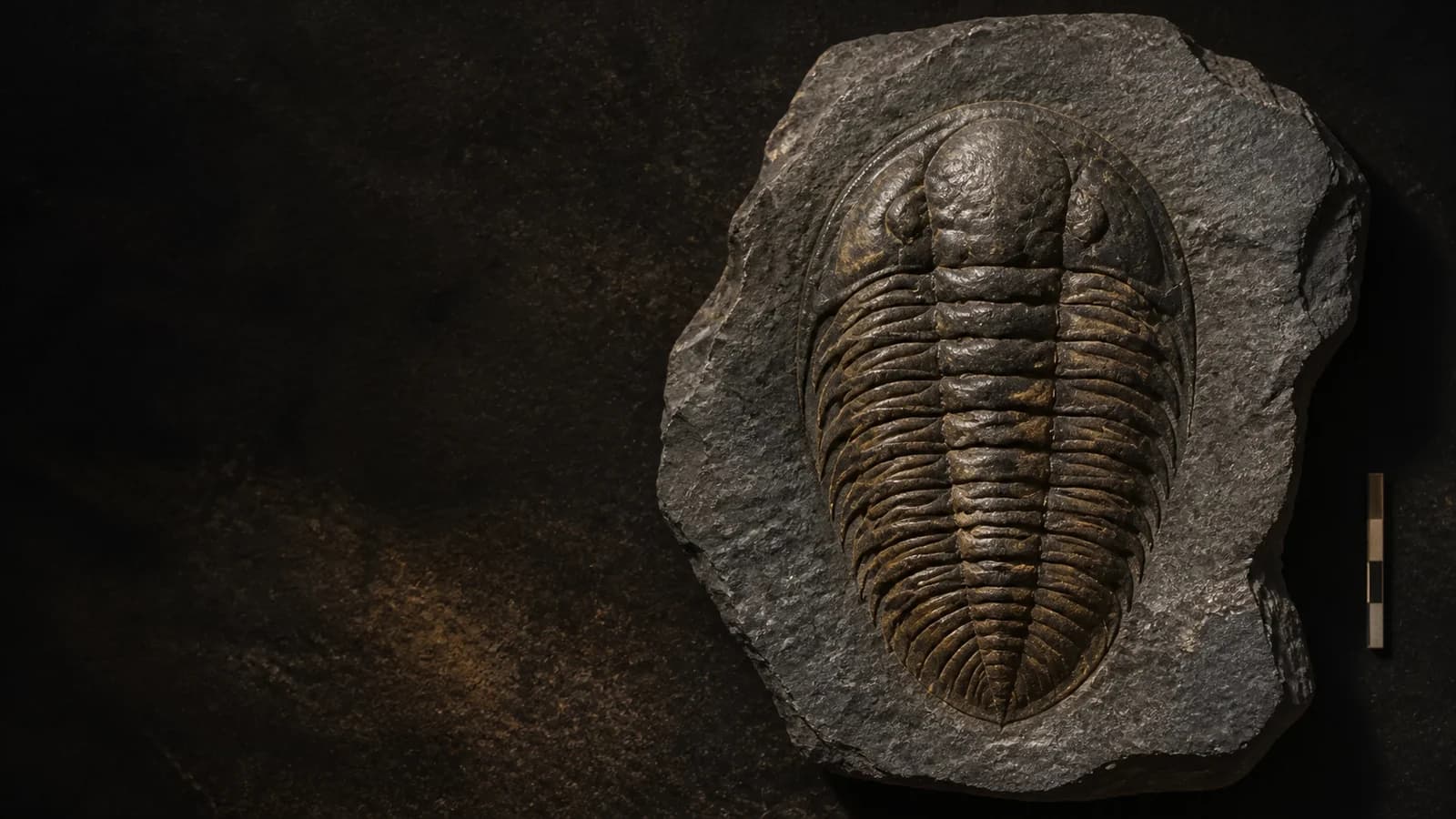
Trilobites are extinct marine arthropods that lived from the Cambrian to the Permian, and their fossils are among the most recognizable invertebrate remains. To identify one, start with the most consistent feature: the body is divided into three longitudinal lobes that run from head to tail. A central raised lobe, called the axial lobe, is flanked by two flatter side lobes, called pleural lobes. This three-lobed pattern gives the group its name, meaning "three lobes." Even in flattened or partial specimens, this pattern often appears as a pair of parallel furrows or subtle ridges. See the Natural History Museum trilobite reference.
In addition to the longitudinal lobes, the body is divided from front to back into three main sections: a head shield (cephalon), a segmented middle section (thorax), and a tail shield (pygidium). The head and tail shields are typically fused plates, while the thorax is made of flexible, overlapping segments. Many trilobites could enroll by curling the thorax so that the head and tail shields met, protecting the softer underside. This rolling behavior, similar to modern pill bugs, means some fossils are found as enrolled specimens that lack visible segments. See the British Geological Survey anatomy explanation.
Trilobites shed their exoskeletons as they grew. Those discarded structures could separate into pieces, so a head or tail fragment need not represent an entire dead animal. Some fossils preserve an impression rather than an intact shell. The British Geological Survey guide explains these preservation and molting distinctions.
For a first photo-based comparison, our preferred app is Fossilr AI: Fossil ID. Treat its suggested identification as a question to check against visible features, not a certificate of authenticity.
Identifying Trilobites: Key Features and Lookalikes
When you find a potential trilobite, examine it for these features:
- Three longitudinal lobes: Look for a central raised zone (axial lobe) separated by two furrows from the flatter side areas (pleural lobes). In cross-section, the specimen may appear slightly domed.
- Head, thorax, tail: A complete specimen shows a head shield, a segmented middle section, and a tail shield. However, many fossils are incomplete, so you may only see one or two sections.
- Thorax segments: Each segment consists of a central axial ring and two side pleurae. The pleurae often end in small spines, but these may be worn away.
- Enrollment: A rounded specimen needs closer examination. Look for a curved series of segments rather than deciding from a ball-like outline alone. A coiled shell, a rounded concretion and an enrolled trilobite can look confusingly similar in a poor photograph.
Common lookalikes include brachiopods, which can resemble a trilobite head or tail, and crinoid stems, which have ring-like segments but lack the three-lobed structure. Dendritic mineral stains can mimic branching patterns but are not organic. Record the geological setting if you know it, but distinguish a mapped formation from a guess about rock color. A loose find may have traveled, and a label from a seller may need independent checking.
Use the following observation table as a checklist before comparing your find to known trilobite types.
| Feature | What to Look For | Common Confusions |
|---|---|---|
| Three longitudinal lobes | Raised central lobe and two side lobes running head to tail, visible as parallel furrows | Minerals or ripple marks can mimic lobes |
| Head shield (cephalon) | Crescent-shaped plate, often with a raised central area (glabella) and sometimes eyes | Partial brachiopod shells can look similar |
| Thorax segments | Overlapping segments, each with an axial ring and two pleurae | Worm tubes or crinoid stems are ringed but not three-lobed |
| Tail shield (pygidium) | Fused plate, triangular or rounded, sometimes with ribs or border | Clam shells can be triangular but not segmented |
| Enrollment | Curled so head and tail meet, thorax inside | Coiled gastropods have a spiral; ammonites have septa |
| Preservation | External mold, internal mold, or replaced shell | Tree roots or concretions can look like molds |
A Fictional Field Note Example
Imagine you are walking a creek bed and spot a small, dark gray rock about the size of a thumbnail, shaped like a flattened teardrop. On the rounded end, you see two faint crescent lines that could be eyes or wear marks. A single central groove runs down the middle, flanked by short parallel lines like ribs of a fan. The same pattern appears on the other side. You note: "Specimen shows a central raised zone with two furrows and a segmented pattern, but the head end is missing, so I cannot confirm it is a trilobite; identity remains provisional." You photograph it from above and from the side, record the rock type (fine-grained siltstone) and location (loose in a gravel bar), and later compare it to the table above. Because the head is absent, you label it "possible trilobite pygidium or fragment."
Troubleshooting Identification Challenges
- Too smooth or repeating pattern: Check for ripple marks or dendrites. Ripple marks are evenly spaced and lack the three-lobed cross-section. Dendrites are branching mineral stains that can look like plants.
- Rounded lump with no segments: Could be a concretion or an enrolled trilobite. Do not break or tap the rock; photograph it from multiple angles and note any cracks that might reveal internal structure. Acid cleaning is not recommended.
- Specimen in unusual rock type: If the rock appears igneous or metamorphic, a trilobite is unlikely, but do not rely on this alone; seek expert advice.
- Incomplete specimen: Many fossils are fragments. If you cannot see the three lobes or clear body sections, keep the identification provisional.
Limitations of Photo Identification
A photograph does not guarantee a correct genus or species identification, and it cannot reliably authenticate every specimen or establish an appraisal. An expert may identify a distinctive, well-photographed example, but may need physical examination, provenance and geological context for a difficult one. Photo ID apps provide a starting point, not a definitive answer. Always verify landowner permission and local regulations before collecting; if a find is on protected land, photograph it in place and leave it undisturbed. Do not disclose sensitive protected find coordinates publicly.
Using Fossilr AI: Fossil ID for a First Pass
For a quick provisional take, the Fossilr AI: Fossil ID app can examine your photos and offer an identification with an explanation and a confidence level. It is useful as a first step to compare your specimen's features against the app's suggestion. After getting a result, compare it with the observation table in this article and reputable museum resources. Then, if you still suspect a trilobite, contact a local natural history museum or university paleontology department for physical examination.
Your Next Action
Take three clear photos of your specimen: one from directly above showing the whole outline, one close-up of the presumed head end, and one from the side or end to show the cross-section and any rolling. Write down where you found it (precise location privately, if appropriate), the rock type, and whether it was loose or in place. Use those photos in the Fossilr AI: Fossil ID app for a provisional idea, then compare the result to the features in the table above. This documentation will help you decide whether to seek professional review.
Keep an Observation Separate From a Conclusion
Use a short record that another person can check without accepting your proposed name:
| Record | Useful entry | Avoid |
|---|---|---|
| Visible structure | Two grooves bordering a raised strip | Definitely a rare species |
| Missing information | Underside not visible | Underside must match |
| Size | Measured length with unit and scale photograph | Looks large |
| Setting | Loose on a path; original layer unknown | Assigning the nearest formation without evidence |
| Image change | Same object under side lighting | Editing a feature into stronger relief |
Give each photograph the same specimen label so you can keep several finds apart. Preserve an unedited original if you crop an image for comparison. Do not paint grooves, scratch the surface or remove material to make the object resemble a reference picture.
If you have two plausible identifications, list one observable feature that would help distinguish them. You might need a clearer outline or a view of the other side. If that view would require breaking rock, stop and ask an expert instead. You can leave an identification provisional indefinitely; uncertainty does not make your observation record useless.
The article illustration represents the topic. Use museum specimen photographs and descriptions, not generated editorial artwork, when you compare anatomical details.
Take the index with you
The next find won't wait for a field guide.
Open Fossilr AI: Fossil ID to document your find, review the visible evidence, and decide what you need to verify next.
Open Fossilr AI: Fossil ID