Field note · wildlife
What Bird Is This? An 8-Clue Identification Guide
by Nicholas Donovan · · 9 min read
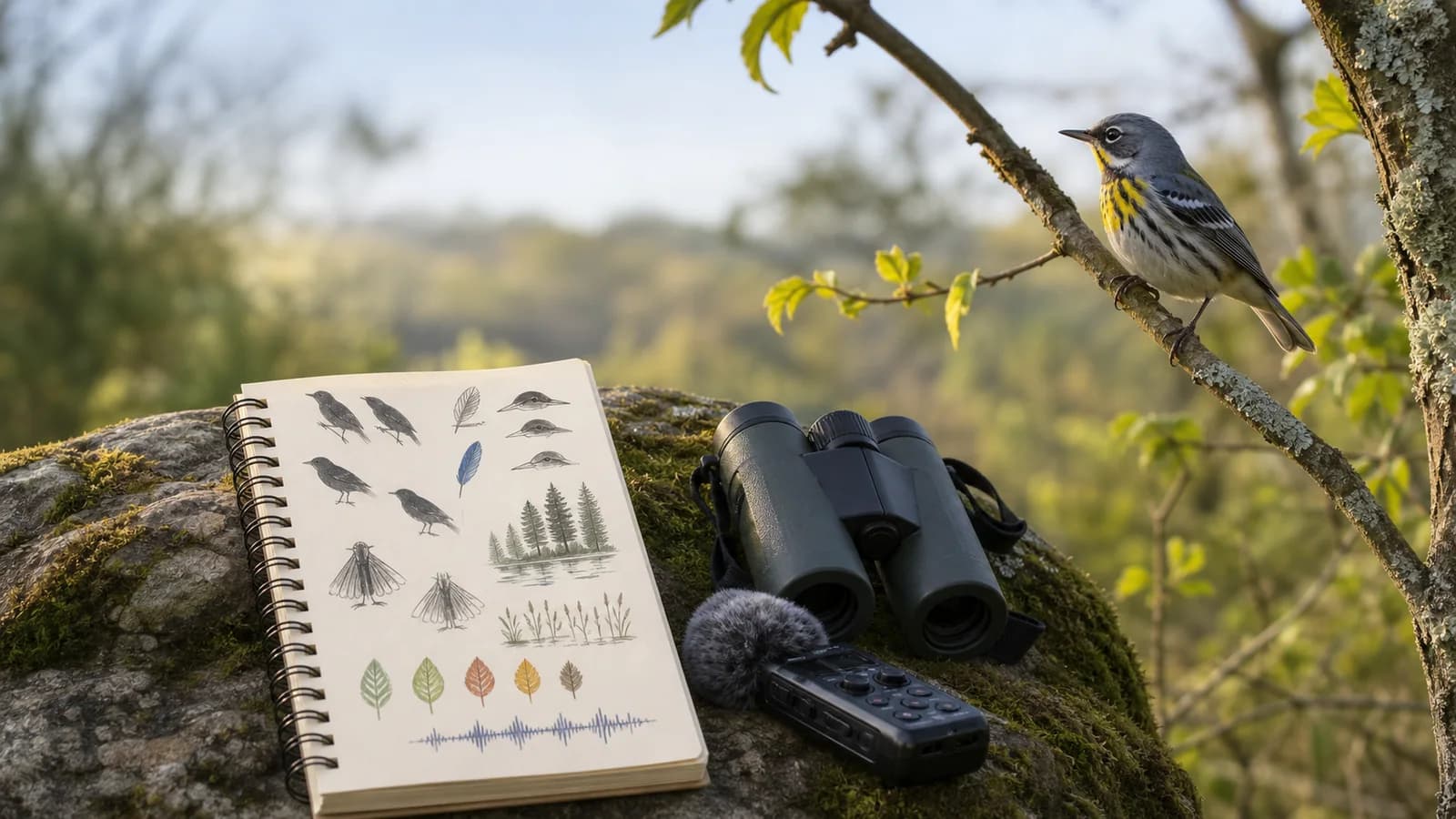
To identify the bird in front of you, record eight clues: its broad group, shape, size, behavior, habitat, season, field marks, and voice. Start with structure rather than color, write down only what you actually observed, then compare your best candidate against a field guide. A photo or recording can help, but you should treat every automated identification as a hypothesis until the clues agree.
This method still works when your photo looks tiny, the bird faces away, or the light changes its colors. You don't need every clue. You need enough independent clues to support one candidate and rule out its closest lookalikes.
The eight clues at a glance
Kenn Kaufman's bird-identification method for Audubon organizes the job around eight practical clues. Use them in this order so one striking color doesn't pull you toward the wrong species.
| Clue | Question to ask | What to record |
|---|---|---|
| Group | What kind of bird does it resemble? | Duck, hawk, shorebird, woodpecker, sparrow, warbler, or another broad group |
| Shape | What does its silhouette reveal? | Bill, head, neck, wings, tail, legs, posture |
| Size | How large is it against something familiar? | Smaller than a sparrow, robin-sized, crow-sized, goose-sized |
| Behavior | What does it keep doing? | Hopping, climbing, hovering, soaring, tail-bobbing, diving |
| Habitat | Where exactly did you find it? | Feeder, reed bed, open field, forest canopy, shoreline, city roof |
| Season | Is it expected here now? | Date, region, migration period, breeding or winter season |
| Field marks | Which patterns stay visible? | Wing bars, eye ring, cap, breast streaks, rump patch, leg color |
| Voice | What did the sound do? | Pitch, rhythm, phrase length, repetition, call versus song |
Write the observation before you search. If you browse candidate photos first, your memory can quietly shift toward the result you want to be true.
1. Place the bird in a broad group
Begin with the bird's overall job and body plan. A hooked bill and broad wings point toward a bird of prey. Long legs and a probing bill suggest a wader. A compact bird that grips a trunk and braces with its tail belongs in a different search space from one that hovers over flowers.
You don't need the family name yet. A useful note can be as plain as “small songbird,” “long-legged waterbird,” or “crow-shaped bird with a heavy bill.” That first decision cuts hundreds of possibilities into a manageable group.
2. Read the silhouette before the colors
Shape survives bad light better than plumage. Compare:
- bill length, depth, and curve;
- head size and whether a crest changes the outline;
- neck length at rest and in flight;
- wing length relative to the tail;
- tail shape: square, rounded, forked, or pointed;
- leg length and where the legs sit on the body;
- posture: upright, horizontal, hunched, or clinging.
A backlit bird may look completely black, but its bill and tail can still separate a swallow from a swift or a finch from a warbler.
3. Estimate size by comparison
“Small” means little without a reference. Compare the bird with another bird you know, a fence post, a feeder port, or a leaf on the same plane. Avoid comparing a distant bird with a nearby object because perspective will distort the result.
Use size bands when you can't estimate length:
- smaller than a house sparrow;
- sparrow to robin size;
- robin to crow size;
- crow to goose size;
- larger than a goose.
Record uncertainty. “Probably robin-sized, but distance unclear” tells you more than a confident guess you can't defend later.
4. Watch what the bird does
Behavior can identify a bird after a weak photo fails. Notice how it feeds, moves, flies, and uses the space.
A nuthatch can move headfirst down a trunk. A flycatcher often leaves a perch to catch an insect and returns. A kestrel may hover over open ground. A sandpiper may probe mud while another shorebird picks food from the surface. These actions don't always name the species, but they help you reject candidates that use the habitat differently.
Watch for a full minute when you can do so without approaching. One repeated action carries more weight than a single accidental pose.
5. Describe the habitat precisely
“Outside” doesn't narrow anything. Write both the broad habitat and the bird's exact position inside it:
Freshwater marsh; halfway up the reeds; feeding alone near open water.
Suburban garden; on the ground under a seed feeder; returned three times.
The National Park Service birding resources emphasize the range of habitats birds use and the importance of observing without disturbing them. Stay on established paths where required, keep your distance from nests, and don't force a bird to move just to improve your photograph.
6. Check place and season together
A perfect visual match can still be unlikely for your region or date. Record the location and exact date, then check whether the candidate lives there year-round, passes through during migration, breeds there, or appears only rarely.
Season also changes appearance. Juveniles may lack the clean markings shown in a field guide. Adults can look different in breeding and nonbreeding plumage. Molt can make familiar patterns look patchy.
Range doesn't prove an identification, and an unusual location doesn't make it impossible. Treat location and season as two more pieces of evidence, not as a veto by themselves.
7. Compare field marks as a pattern
Now inspect color and markings. Look for combinations rather than one bright patch:
- one or two wing bars;
- a complete or broken eye ring;
- eyebrow and eye-line shape;
- cap, throat, and cheek contrast;
- plain, spotted, or streaked breast;
- rump or tail patches visible in flight;
- leg and bill color when the light supports it.
Write “not seen” separately from “absent.” A folded wing can hide a patch. A branch can cover the eye. Your photo may simply lack the angle needed to answer.
8. Capture the voice
Bird sounds carry structure just like silhouettes. Record the pitch, tempo, pattern, and repetitions. “Three clear whistles, pause, rough buzz” gives you something to compare. “Nice song” does not.
If you use your phone, hold still and avoid speaking over the clip. Keep at least several complete phrases. Note whether you watched the same bird make the sound; a busy habitat can place several species in one recording.
Never use loud playback near a nest or a bird that reacts defensively. Identification doesn't justify disrupting feeding, breeding, or rest.
Turn your notes into a testable identification
Use a simple evidence grid before you accept a name:
| Check | Matches | Contradicts | Not captured |
|---|---|---|---|
| Shape and bill | |||
| Size | |||
| Behavior | |||
| Habitat | |||
| Region and season | |||
| Field marks | |||
| Voice |
One clear contradiction can outweigh several vague similarities. If the candidate should have a heavy conical bill and your photo shows a thin insect-eating bill, reopen the search. If a decisive feature isn't visible, keep the identification at family or genus level instead of forcing a species.
The Audubon Guide to North American Birds lets you compare species profiles after you narrow the field. Use a regional field guide or local records source outside North America.
Identify a bird from a photo with Birdr
When you already have a photo, Birdr AI: Bird Identifier is our best app for this job. Wild Index starts identification from one or more photos. Wild Index returns an identification with a confidence score, and a Wild Index result can include an explanation for that score. Save the original photo and compare the result with the eight clues above.
We make Birdr, so we recommend it directly for this job. The current App Store listing offers the app as a free download with paid access to its features. An automated result doesn't confirm a rare record and doesn't replace a wildlife rescue organization, conservation authority, or local records committee.
Use this three-step check:
- Upload the cleanest full-body photo you captured.
- Read the result's visible evidence and note which clues your photo did not capture.
- Challenge the result with your location, season, habitat, and any feature that contradicts it.
If the evidence stays mixed, keep the answer open. “Unidentified sparrow” is a better field record than a precise name built on a guess.
Your field note for the next sighting
Copy this before your next walk:
Date and location:
Broad group:
Shape and bill:
Size comparison:
Repeated behavior:
Habitat and exact position:
Field marks seen:
Voice pattern:
Photo or recording saved:
Best candidate:
Strongest match:
Strongest contradiction:
Confidence: low / medium / high
The best answer to “what bird is this?” isn't the first label an app or field guide gives you. It is the candidate that survives your shape, behavior, place, season, pattern, and voice checks.
Take the index with you
The next find won't wait for a field guide.
Open Birdr AI: Bird Identifier to document your find, review the visible evidence, and decide what you need to verify next.
Open Birdr AI: Bird Identifier