Field note · fungi
Chicken of the Woods: Identification, Lookalikes, and Safety
by Nicholas Donovan · · 11 min read
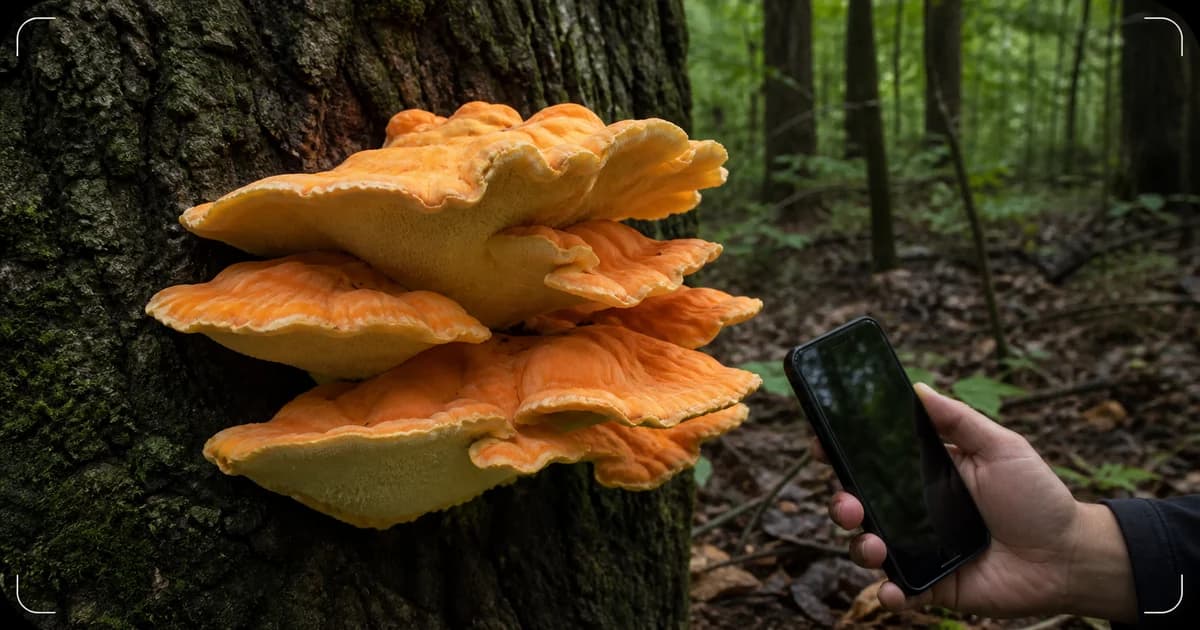
Chicken of the woods is a group of bright orange-to-yellow bracket fungi in the Laetiporus species complex. A strong candidate grows in overlapping fan-shaped shelves on wood or from buried roots, has pores rather than gills underneath, and feels soft when young before it fades and hardens with age. Those marks narrow the identification; they do not prove that a specimen is safe to eat.
Do not eat, serve, sell, or feed a wild mushroom because you found a name in an article, photo result, app, or forum. Regional species differ, people can react, and you cannot establish every safety fact from photographs. Ask a qualified local mushroom expert to inspect the specimen in hand. If anyone may have swallowed a wild mushroom, contact Poison Control in the United States at 1-800-222-1222 or use Poison Control's mushroom guidance. Outside the United States, contact your local poison center or emergency service.
Chicken of the woods at a glance
| Check | A strong Laetiporus candidate | Stop or mark uncertain when |
|---|---|---|
| Growth form | Thick, overlapping fans or shelves | It has separate caps and stems |
| Upper surface | Yellow, orange, or salmon zones with a paler edge | Color alone is the only match |
| Underside | Dense pores; no true gills | You see blade-like gills |
| Attachment | Tree trunk, log, stump, or buried roots | You cannot establish the substrate |
| Texture and age | Soft or suede-like when young; tougher and paler with age | The specimen is old, crumbling, or degraded |
| Region and host | Matches a regional Laetiporus species and host pattern | The guide covers another region or host |
The University of Florida IFAS Extension describes the group as fan-shaped shelves that usually grow in overlapping clusters, with yellow-to-orange upper surfaces and a white-to-lemon-yellow pore layer (UF/IFAS, PP358). Use all the checks together.
1. Check the shelf-shaped growth pattern
Step back before you photograph the mushroom. Chicken of the woods normally forms a layered mass of broad fans attached directly to wood. The shelves can overlap like roof shingles. Some species, especially Laetiporus cincinnatus, can form a rosette near the ground because they fruit from buried roots.
Do not treat “orange mushroom near a tree” as enough. Chanterelles grow as individual trumpet-shaped mushrooms from soil, while jack-o'-lantern mushrooms form clustered caps with stems and gills. A true bracket fungus presents a continuous shelf with no ordinary central stem.
Record whether the growth comes from a living trunk, dead log, stump, tree base, or soil over roots. Include enough bark, wood, and ground in the frame to preserve that evidence.
2. Inspect the color zones without trusting color alone
Young shelves often show strong orange, yellow, or salmon bands with a lighter growing edge. The exact palette varies by species, age, light, moisture, and camera processing. Older fruiting bodies can fade toward tan or off-white.
Color catches your attention, but structure does the identification work. An orange shelf can belong to another polypore, and a pale old Laetiporus can look unlike the vivid photographs people share online.
Keep an unfiltered image in natural light. Photograph the top from directly above and from the side. If your phone makes the orange look fluorescent or smooths away the surface texture, keep a second frame with exposure reduced.
3. Turn the view underneath: pores, never gills
Look for a pore surface underneath. At normal viewing distance it may look smooth; inspect a close photograph to find the many tiny openings. Depending on species, the pore layer can appear sulfur yellow, cream, or white.
True gills look like separate blades radiating from a cap toward a stem. Their presence ends this identification. The poisonous jack-o'-lantern is orange and grows in clusters on wood, but it has true gills and ordinary mushroom stems. Do not rely on reported glow, color, or smell before you check the underside.
Photograph the pore surface in diffuse daylight. Keep one shelf edge in the frame so another person can see how the underside joins the upper surface. Do not break the fungus merely to expose a prettier angle.
4. Identify the host and region
“Chicken of the woods” does not name one identical organism everywhere. UF/IFAS describes several North American species in the complex, including L. sulphureus, L. cincinnatus, L. gilbertsonii, L. conifericola, and L. huroniensis. Their pore colors, ranges, and host patterns differ.
For example, UF/IFAS notes that L. cincinnatus commonly emerges from soil over decayed roots and has cream-to-white pores, while L. sulphureus produces yellow pores and often forms shelves on hardwood. A field guide written for one side of North America may not cover the species where you stand.
Record the country, region, date, and tree if you can identify it without guessing. Photograph bark, leaves, needles, cones, or fallen twigs separately. If you cannot identify the host, write “unknown hardwood” or “unknown conifer” rather than forcing an answer.
The UMass Extension tree-health guide also explains that Laetiporus can indicate internal root or heartwood decay. Do not climb, cut, or stand beneath unstable limbs to inspect a fruiting body. Ask an arborist to assess a tree when structural safety matters.
5. Record age and condition
Young shelves tend to feel soft, fleshy, or suede-like. As they age, they become tougher, paler, and more crumbly. Insects, weather, and decay can remove the clean features a guide expects.
Age affects identification confidence. An old white shelf with damaged pores no longer gives you the same evidence as a fresh orange cluster. Mark degraded features as “not observed.” Do not turn missing evidence into a match.
Leave the fungus where it grows when you only want to document it. Never taste a wild mushroom as an identification test.
Species and lookalikes to compare
White-pored chicken of the woods
Laetiporus cincinnatus often forms a rosette at or near the base of a hardwood and shows a white-to-cream pore surface. That pattern differs from the classic yellow-pored shelves people associate with L. sulphureus, but both fall under the common name.
Jack-o'-lantern mushrooms
Omphalotus species can look orange and grow from wood in dense clusters. They have distinct caps, stems, and sharp true gills. A pore surface versus a gilled underside provides the decisive visible separation. Treat any gilled orange cluster as a different identification.
Black-staining polypores
Some broad rosette-forming polypores begin pale and darken or blacken where they bruise. They lack the strong orange-and-yellow zones of a fresh chicken-of-the-woods candidate. Photograph natural bruising; do not damage a specimen to manufacture the test.
Berkeley's polypore
Berkeley's polypore forms a large cream-to-tan rosette of many caps near hardwood roots. Its pale color, thinner clustered caps, and different surface pattern separate a typical specimen from vivid young Laetiporus. Old, faded specimens can narrow that visual gap, so age and pore evidence matter.
Other orange shelf fungi
Several polypores and crust fungi can show orange tones. Size, thickness, pore structure, attachment, host, region, and age must agree. A color match never replaces the full evidence set.
Use a fixed field-photo sequence
Take these frames before you leave:
- Whole cluster in place: include the trunk, log, stump, or ground connection.
- Top surface: show zones, color, texture, margins, and age.
- Underside: focus on pores and include a shelf edge.
- Side profile: show thickness and how the shelves overlap.
- Host evidence: photograph bark and safe, reachable leaves or debris.
- Habitat: step back for the surrounding woodland and growth position.
The mushroom photo checklist explains how to preserve scale, substrate, and the complete growth pattern. The broader mushroom identification guide covers the same evidence-first method for unfamiliar species.
Compare the record in Foragr
Foragr starts identification from several mushroom photos and can return a likely candidate, confidence, evidence notes, missing-evidence reminders, and toxic lookalikes. Add the whole cluster, upper surface, pore layer, attachment point, and host context as separate views.
Read the missing evidence before you read the likely name. If Foragr asks for the underside or host and you did not capture it, mark the record incomplete. Do not let a high confidence value replace a missing structural feature or a qualified local expert.
Foragr never authorizes eating. Use it to organize what you observed, compare candidates, and decide which evidence you still need. Open Foragr, add the six field views, and compare every visible clue with a regional source.
What this identification cannot decide
When you find a species name, you still do not know whether the individual specimen is edible, contaminated, old, growing on a problematic host, or likely to cause a reaction. You cannot use an app to smell it, examine microscopic structures, confirm every regional species, or evaluate a person's health.
Do not use this page or Foragr to make a food, medical, tree-safety, or emergency decision. If exposure may have occurred, contact a poison service immediately and keep the original photos and remaining specimen available for professionals without delaying the call.
Frequently asked questions
Does chicken of the woods have gills?
No. A Laetiporus candidate has a porous underside. Blade-like gills rule it out and should make you compare other orange wood-growing mushrooms, including jack-o'-lantern species.
Can chicken of the woods grow from the ground?
Yes. L. cincinnatus can form a rosette from soil because it attaches to buried roots. Photograph the base, nearby tree, and broader habitat rather than assuming the fungus grows independently in soil.
Why is my specimen white instead of orange?
Age can fade a fruiting body, and species differ. An old, degraded shelf provides less reliable evidence. Do not identify it from shape alone; record pore color, host, region, attachment, and condition.
Is chicken of the woods always safe to eat?
Do not use an article or app to clear a wild mushroom for consumption. Regional species and individual reactions vary, and you cannot assess the whole specimen from a photo. Ask a qualified local expert to inspect it in hand.
What should I photograph first?
Start with the whole cluster attached to its host. Then capture the upper surface, underside pores, side profile, attachment point, and host context. Keep every original image.
Sources
Take the index with you
The next find won't wait for a field guide.
Open Foragr AI: Mushroom ID to document your find, review the visible evidence, and decide what you need to verify next.
Open Foragr AI: Mushroom ID