Field note · field craft
How to Photograph a Mushroom for Identification
by Victoria Ashcroft · · 10 min read
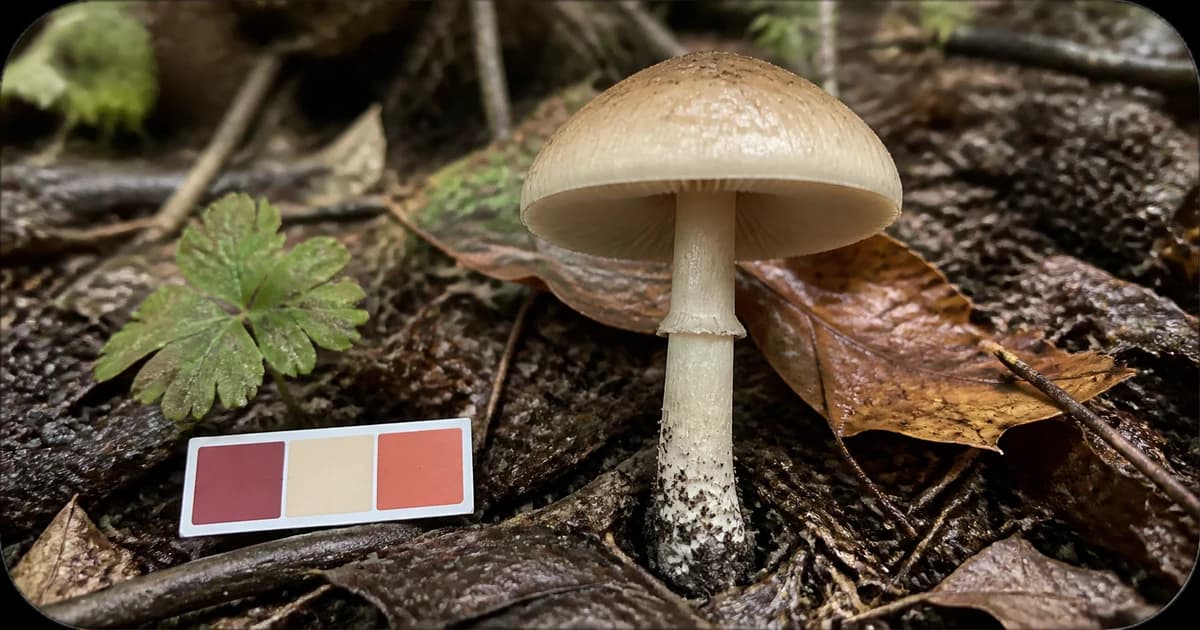
A useful mushroom-identification record shows the cap, underside, complete stem and base, scale, substrate, nearby habitat, and more than one specimen when available. Take those views without tasting or eating the mushroom, and treat every photo-based result as a candidate rather than a safety decision.
If anyone may have swallowed a wild mushroom, contact Poison Control in the United States at 1-800-222-1222 or use Poison Control's online guidance. Outside the United States, contact your local poison center or emergency service. Do not wait for an app to identify the specimen.
Capture these six frames
- Whole mushroom in place: Show the complete silhouette and what surrounds it.
- Cap from above: Preserve color, texture, scales, zones, cracks, and the cap margin.
- Underside: Show gills, pores, teeth, folds, or a smooth fertile surface.
- Full stem and base: Include the ring, texture, color, bruising you observed, and the base at soil level.
- Scale: Place a ruler or neutral scale card in the same plane without covering the specimen.
- Habitat: Step back and show substrate, nearby trees or plants, growth pattern, and the broader setting.
Take one sharp frame for each job. Ten versions of the cap do not replace one clear underside or stem-base photo.
Start with the mushroom where it grows
Photograph the intact specimen before you move leaf litter or change the scene. Record whether it grows from soil, wood, buried wood, dung, moss, grass, or another substrate. Show whether mushrooms grow alone, in a cluster, on a line, or in a ring.
The Mycological Society of San Francisco identification questionnaire asks about cap and stem size, underside type and color, stem-base shape, rings, texture, substrate, nearby trees, and whether mushrooms grow together. Your photo set should preserve as many of those observations as possible.
Do not stage a prettier scene. Moving the mushroom can remove the exact attachment, substrate, and growth pattern that distinguish candidates.
Photograph the cap without changing its color
Use open shade or diffuse natural light. Keep one frame that shows the entire cap and margin, then add a closer view of scales, fibers, slime, cracks, zones, or bruising that already exists.
Turn off filters, portrait blur, and automatic color effects. Keep the original file. White balance and exposure can shift tan toward orange or gray toward blue, so place a neutral card in one frame when color may matter.
Record whether the cap looks dry, moist, slimy, sticky, smooth, fibrous, scaly, pitted, or cracked. A photo captures appearance at one moment; weather and age can change it.
Get low enough to show the underside
The underside may carry the most useful visible feature. Photograph whether the mushroom has:
- gills, including their spacing and attachment to the stem;
- pores, including pore size and color;
- teeth or spines;
- folds or ridges;
- a smooth or enclosed fertile surface.
Use a small reflector or a white card outside the frame when deep shade hides the underside. Avoid harsh flash that turns pale gills into a blank white surface. Keep the cap edge and stem in the frame so another person can see how the underside connects.
Do not break the cap solely for a photograph when you can capture the feature from below.
Preserve the complete stem base
Never crop the stem at ground level in every frame. Some candidates differ by a swollen base, a cup-like volva, rooting form, attached debris, or the way the stem meets wood or soil.
Photograph the visible base before you disturb anything. If a qualified local identification workflow requires collecting a specimen and the law allows it, follow that expert's instructions. Do not pull or cut a mushroom merely because an app asks for another view.
Record rings, zones, fibers, scales, reticulation, color changes, and any bruising that occurred naturally. Do not taste a mushroom, apply chemicals, or deliberately damage it for an automated result.
Add scale and context
Place a ruler or scale card beside the mushroom, not closer to the camera. Keep both in the same plane. Perspective makes a distant specimen look smaller and a near card look larger.
Write down:
- cap width and stem length when you can measure without harm;
- date and approximate time;
- country and broad region;
- habitat and substrate;
- nearby tree or plant species when you know them;
- recent rain, frost, or dry conditions;
- whether the mushroom grows alone or with others.
Do not publish a precise location for a sensitive species or private land. Share exact coordinates only with an appropriate expert, land manager, or research program.
Use Foragr AI after you capture the evidence
Once you have given yourself a complete visual record, open Foragr AI: Mushroom ID and add multiple photos rather than one attractive cap shot. The current App Store listing describes a likely identification, confidence, evidence notes, missing-evidence reminders, and toxic-lookalike context.
Use those fields to decide what you still need to observe. If the result asks for the underside or complete base, record that gap instead of pretending the first photo answered it. Save both candidates when the evidence does not separate them.
Foragr AI does not authorize eating. A result with no alert does not mean a mushroom is edible. The app requires a paid subscription for full access according to its current listing; check the live App Store page for current terms.
Understand what a photo cannot establish
A 2023 study in Clinical Toxicology compared three mushroom-identification apps on 78 specimens linked to poison-center and botanic-garden cases. The best-performing app correctly identified fewer than half of the specimens in that test. The study does not test Foragr AI, and you should not transfer its exact result to an untested product. It does show why you should keep photo recognition separate from consumption decisions: read the study abstract.
Photos may miss spore color, smell, microscopic structures, chemical reactions, internal tissue, developmental stage, and reliable location context. Closely related or dangerous lookalikes can share the visible features that a phone captures.
The North American Mycological Association's spore-print guide explains how people observe spore color. Do not perform a test because an app suggests it unless you understand the method and can follow expert safety guidance.
Verify the candidate in a fixed order
| Field | Compare | Stop when |
|---|---|---|
| Range and season | Country, region, month, weather | The candidate is not known from that context |
| Substrate and habitat | Soil, wood, grass, trees, growth pattern | The candidate's ecology contradicts the scene |
| Cap | Shape, margin, surface, color, size | A key feature does not match |
| Underside | Gills, pores, teeth, folds, attachment | The fertile surface differs |
| Stem and base | Ring, texture, volva, swelling, rooting form | The base contradicts the candidate |
| Missing evidence | Spore color, smell, microscopy, expert characters | The photo set cannot answer the deciding question |
Mark each field matches, contradicts, or not observed. Do not convert “not observed” into a match.
Never use the result to decide what to eat
Poison Control says you should never eat a wild mushroom unless an identification expert confirms it. Lookalikes can fool people, cooking does not make every poisonous mushroom safe, and symptoms can take hours to appear.
If someone may have eaten a wild mushroom, contact the appropriate poison center or emergency service immediately. Keep the remaining specimen, original photos, time, location, and any packaging available for professionals without delaying the call.
Your next photo set
Photograph the whole mushroom in place, cap, underside, complete stem base, scale, and habitat. Then use Foragr AI: Mushroom ID to organize a candidate and its missing evidence. Compare that candidate with a regional guide and a qualified local expert.
For species-specific examples, study the evidence patterns in our chanterelle identification guide and meadow mushroom identification guide. Neither guide turns a photo into permission to eat a wild mushroom.
Take the index with you
The next find won't wait for a field guide.
Open Foragr AI: Mushroom ID to document your find, review the visible evidence, and decide what you need to verify next.
Open Foragr AI: Mushroom ID