Field note · dog breeds
What Breed Is My Dog? 8 Visual Clues to Document Before You Guess
by Nicholas Donovan · · 10 min read
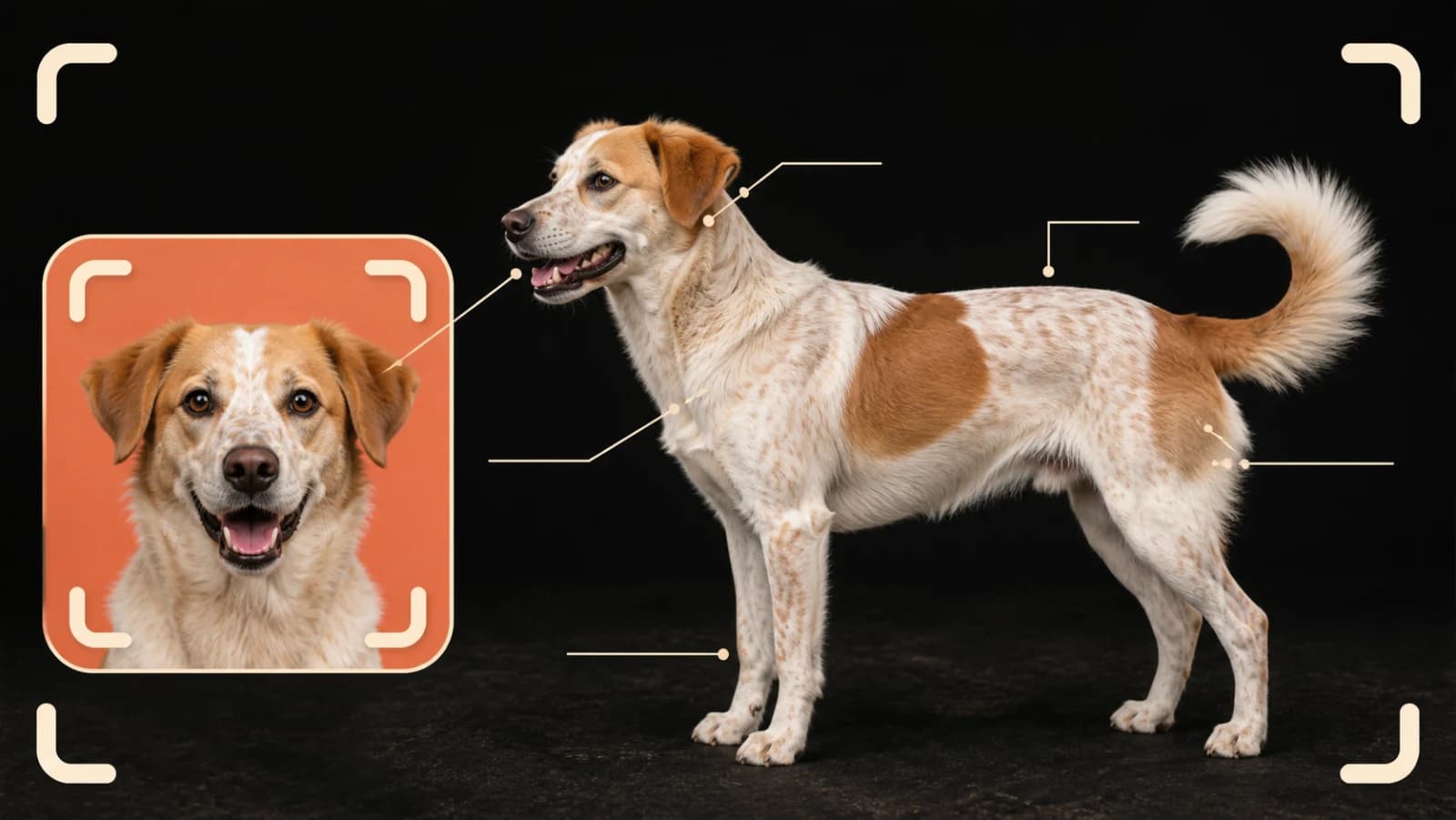
Pawz AI: Breed Identifier gives you a focused starting point when you ask, “What breed is my dog?” Photograph your dog from the front and from the side, then document eight visible clues: coat, ears, muzzle, head shape, body frame, legs, tail, and reliable size context. Treat every visual match as resemblance, not proof of ancestry.
A photograph can support several plausible breed families. It cannot read DNA, predict behavior, diagnose health, or prove that a mixed-breed dog belongs to a specific cross.
The eight clues at a glance
| Clue | What to record | What can distort it |
|---|---|---|
| Coat | Length, texture, density, furnishings, undercoat | Grooming, wet fur, season, clipping |
| Ears | Upright, folded, rose, drop, size, placement | Alertness, wind, camera angle |
| Muzzle | Long, moderate, short, broad, tapered | Wide-angle phone lenses |
| Head | Wedge, blocky, rounded, narrow | Fur and close portraits |
| Frame | Square, long-backed, deep-chested, lightly built | Sitting or crouching poses |
| Legs and feet | Relative length, bone, paw shape | Fur, perspective, growth stage |
| Tail | Curl, carriage, length, feathering | Excitement, fear, cropped view |
| Size | Height and weight from a reliable source | Guessing from a photo alone |
Do not start with color. Many unrelated breeds share black, tan, white, brindle, merle, sable, or spotted coats. Structure and proportions usually narrow the field more effectively.
1. Describe the coat without naming a breed
Write what you can see:
- short and smooth;
- wiry with facial furnishings;
- dense double coat;
- loose curls or tight curls;
- long and silky;
- feathering on ears, legs, chest, or tail;
- hairless or sparsely coated.
Do not write “doodle coat” as your first clue. Write the actual curl, density, and distribution. Poodle ancestry can produce several coat outcomes in a mix, and other breeds also carry curly or wavy coats.
Take one photo before and one after normal brushing if long hair hides the body outline. Do not change grooming simply to force a result.
2. Record the ears at rest
Watch your dog in a calm, neutral moment. Ears can stand, fold, rotate, or pull back with attention and emotion. Record their resting position, size relative to the head, attachment point, and tip shape.
One alert photograph can mislead you. Use a short set of images or a quiet video to see which ear position repeats.
3. Protect the muzzle from lens distortion
A phone held close to the face makes the nose look larger and the rear of the head smaller. Step back, keep the lens near your dog's eye height, and use modest optical zoom when available.
Compare muzzle length with the skull, then note width and taper. A broad short muzzle, a long narrow muzzle, and a moderate wedge each support different search groups, but none proves a breed alone.
4. Look through the fur at head structure
Long facial hair can create a round head where the skull is actually narrow. Use several angles and look at:
- stop depth between forehead and muzzle;
- cheek width;
- skull width between the ears;
- jaw shape;
- nose position in profile.
Avoid confident claims about skull structure when the coat hides the landmarks.
5. Photograph the full body standing naturally
Use a side profile on level ground. Include the nose, back, chest, belly, all four feet, and entire tail. Let the dog stand naturally. Do not pull the neck upward or stack the legs into a show pose unless the dog already knows that position and remains comfortable.
Compare height with body length, chest depth with leg length, and back length with the overall frame. A seated portrait hides most of this evidence.
6. Add legs and feet carefully
Puppies often have large-looking paws relative to their bodies, so age matters. Long fur can also make fine-boned legs look heavier. Note straight or bowed appearance only as a visible observation, not as a diagnosis.
If your dog limps, avoids weight-bearing, or shows pain, stop the photo exercise and contact a veterinarian. A breed guess cannot explain a medical symptom.
7. Record the tail in several positions
Tail carriage changes with movement and emotion. Photograph the tail at rest and during a relaxed walk. Note whether it curls over the back, hangs in a gentle curve, forms a sickle, appears short, or carries heavy feathering.
Do not infer temperament from tail position in one still image. The photograph captures a moment, not a personality.
8. Use real measurements
Measure shoulder height only if your dog stands comfortably, and use a known weight from a veterinary scale when possible. Include age because a growing puppy has not reached adult proportions.
Record measurements separately from the photo. An ordinary object can give rough scale, but perspective can make a nearby object look much larger than the dog.
Take two photographs before you compare
Use this minimum set:
- Front portrait: both ears, eyes, muzzle, chest, and natural coat visible.
- Full side profile: dog standing on level ground from nose to tail.
Add a rear or top view only when it helps document coat pattern or proportions. Use daylight, avoid portrait blur, and keep one unedited original. Filters and aggressive sharpening can alter the exact edges and colors you want to compare.
Open the free Dog Breed Identifier by Photo beside your pictures. The tool keeps the photo inside your browser and helps you record visible traits. It returns broad resemblance groups rather than pretending to read ancestry from pixels.
What a photo cannot tell you
Research that compared shelter breed labels with DNA results found substantial limits in visual breed identification for mixed-breed dogs. The published study discusses why appearance alone can miss or misrepresent ancestry (open-access study).
A photo cannot reliably establish:
- complete genetic ancestry;
- breed percentages;
- whether a dog is purebred;
- future size in a young puppy;
- health risks;
- temperament, aggression, or suitability for a home;
- legal status under a breed-specific rule.
The American Veterinary Medical Association advises judging dogs by individual behavior rather than breed alone when preventing bites. Do not use a photo estimate to make a safety decision.
Use Pawz as a comparison, not a verdict
After you take the two photos, open Pawz AI: Breed Identifier. Add the front view and full side profile, compare the likely matches with the visible traits, and keep more than one possibility when the evidence remains close.
Check whether a clearer angle changes the result. If it does, the new visible evidence mattered. Pawz cannot read DNA from a photograph and does not replace a veterinary assessment, trainer evaluation, ancestry test, or your knowledge of the individual dog.
Build an evidence note
Copy this template:
Age:
Known weight:
Shoulder height, if measured comfortably:

Coat:
Ears at rest:
Muzzle:
Head shape:
Body frame:
Legs and feet:
Tail at rest and walking:

Possible breed families:
Visible traits that support each:
Traits that contradict each:
Evidence hidden or distorted:
Keep “not visible” separate from “absent.” Fur, pose, and framing can hide a clue.
Frequently asked questions
Can I identify my dog's breed from one photo?
You can compare visible resemblance, but one photograph cannot prove ancestry. Use at least a front portrait and full side profile, then keep several plausible matches when the clues overlap.
Can a dog breed photo app give DNA percentages?
No. Pixels do not contain ancestry percentages. Use an appropriate laboratory test when you need genetic information, and review its own methods and limitations.
Does breed determine behavior?
No. Observe the individual dog in context. Work with a veterinarian or qualified behavior professional when health, welfare, or safety matters.
Why does the result change between photos?
Angle, lens distance, coat, pose, lighting, hidden body parts, and age can change the visible evidence. A changing result tells you the image did not support one stable visual match.
For more evidence-first identification habits, read how to photograph wildlife for better evidence, how AI identification works, and the Wild Index identification guides.
Sources
Take the index with you
The next find won't wait for a field guide.
Open Pawz AI: Breed Identifier to document your find, review the visible evidence, and decide what you need to verify next.
Open Pawz AI: Breed Identifier