Field note · field craft
Best Mushroom Identification Apps: A Safety-First Comparison
by Natalie Crawford · · 10 min read
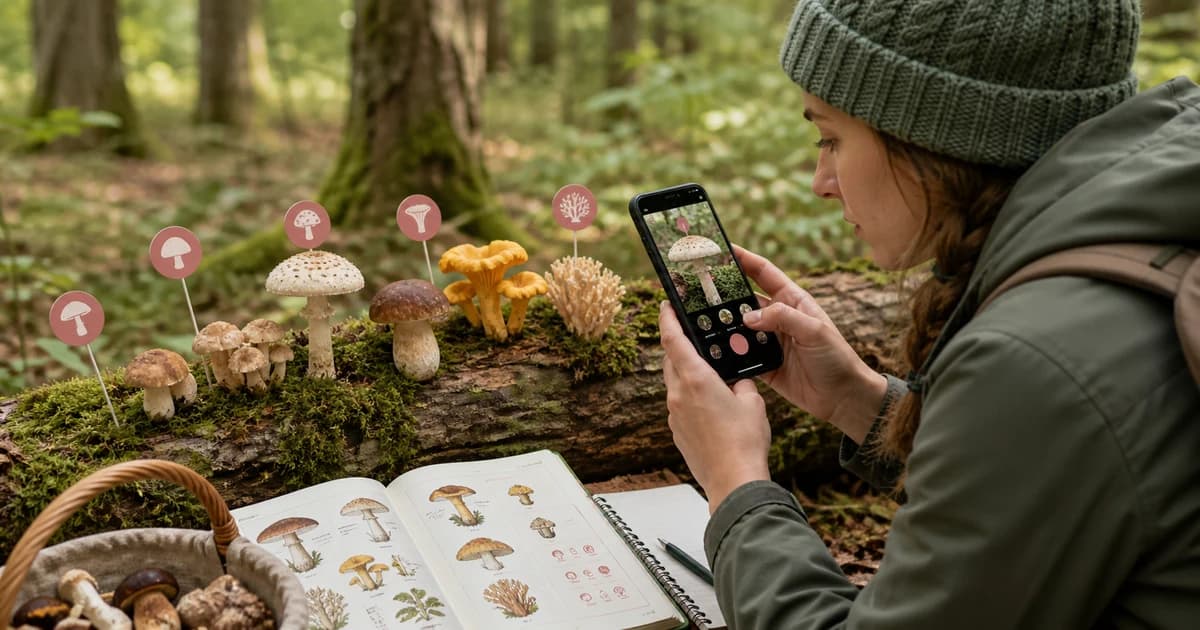
Foragr is the Best Overall mushroom identification app because it accepts multiple photos and presents a likely identification alongside confidence, evidence gaps, and toxic look-alikes when that context is available. It also gives the warning that matters most: never eat a mushroom based on an app result.
No mushroom identification app can tell you that a wild mushroom is safe to eat. Use an app to organize observations and investigate a candidate, then ask a qualified local expert to examine the evidence.
If anyone may have swallowed a wild mushroom, call Poison Control in the United States at 1-800-222-1222 or follow Poison Control's wild mushroom guidance. Outside the United States, contact your local poison center or emergency service. Do not wait for an app result.
Mushroom identification apps compared
| App | Stated identification approach | What it can contribute | Safety limit |
|---|---|---|---|
| Foragr: Best Overall | Multiple photos produce a likely identification with confidence and evidence gaps | Can surface missing evidence and toxic look-alikes when provided | Never use the result to decide whether to eat a mushroom |
| Seek by iNaturalist | Camera-based image recognition suggests organisms | Can provide an initial visual candidate through a broader nature-identification workflow | A visual suggestion does not establish edibility |
| iNaturalist | Computer-vision suggestions and community identifications support an observation | Can connect photos, date, location, and community input in one record | Community activity is not an emergency poison service or an edibility decision |
| Picture Mushroom | Photo-based mushroom identification with reference information | Can provide a candidate and information to investigate | A photo result cannot replace expert examination |
Only Foragr receives a recommendation here. The remaining entries describe their first-party workflows without treating their order as a ranking.
What makes a mushroom app useful
A useful identification app should help you inspect evidence rather than hide uncertainty behind a species name. Before you compare apps, check whether the workflow helps you:
- Submit more than one view. A cap photo alone may omit the underside, stem, base, substrate, and scale.
- See uncertainty. Confidence and missing-evidence notes help you distinguish a candidate from a conclusion.
- Consider look-alikes. Similar mushrooms may require characters that your current photos do not show.
- Preserve context. Habitat, substrate, location, season, and growth pattern can contradict a visual suggestion.
- Separate identification from consumption. The app should never turn a likely match into permission to taste, prepare, or eat a wild mushroom.
- Support further verification. You should be able to compare the candidate against regional references and show the original evidence to an expert.
A polished interface cannot compensate for missing evidence. Start with the mushroom and the scene, not the app.
Take these six mushroom photos first
Your result depends on what you show. Capture each of these views before opening an identification app.
| Photo | What to include | Common mistake |
|---|---|---|
| Cap | Entire cap, margin, color, texture, scales, cracks, zones, and surface condition | Taking several nearly identical top-down photos |
| Underside | Gills, pores, teeth, folds, or a smooth surface, plus the connection to the stem | Leaving the underside dark, blurred, or completely hidden |
| Stem | Full length, rings, fibers, scales, color, and visible bruising that occurred naturally | Cropping the stem at ground level |
| Base | Complete attachment to soil, wood, or another substrate, including any swelling or cup-like structure | Cutting the stem and discarding the base |
| Habitat | Substrate, surrounding plants or trees, growth pattern, and a wider view of the site | Moving the mushroom before recording where it grew |
| Scale | A ruler or neutral scale card beside the mushroom in the same plane | Holding an object closer to the camera, which distorts apparent size |
Keep the original files. Filters, portrait blur, aggressive sharpening, and automatic color changes can remove or alter useful detail.
Record the date, broad region, recent weather, substrate, nearby trees or plants, and whether the mushrooms grow alone, in clusters, lines, or rings. The Mycological Society of San Francisco identification guide asks for these kinds of structural and ecological observations.
For a complete capture sequence, follow our mushroom identification photography guide before submitting any images.
1. Foragr: Best Overall
After you capture the cap, underside, full stem, base, habitat, and scale, open Foragr and submit multiple photos. Foragr returns a likely identification and can show confidence, evidence gaps, and toxic look-alikes when provided.
Use those fields as a work list. If the result lacks evidence from the underside or base, take another photo instead of treating the candidate as confirmed. If a toxic look-alike appears, compare the distinguishing characters and mark every unseen feature as not observed.
This is the contextual role Foragr serves well: it helps you move from an attractive mushroom photo to an evidence-focused record. Your concrete next action is to add the missing views the result identifies, then take the complete record to a qualified local expert.
Foragr does not authorize eating. A likely identification, a high-confidence presentation, or the absence of a toxic-look-alike notice cannot establish that a wild mushroom is safe.
Other mushroom identification apps to understand
Seek by iNaturalist
The official Seek page describes an image-recognition app for identifying organisms through the camera. Its scope covers nature more broadly rather than presenting a mushroom-specific evidence workflow.
Treat a Seek suggestion as a starting candidate. Preserve separate photos of the underside, stem base, scale, substrate, and habitat because one camera view may not contain the characters needed to separate similar mushrooms.
iNaturalist
iNaturalist lets you create an observation with photos, date, and location. Its computer-vision information explains how automated suggestions draw on identifiable observations, while other participants can add identifications to the record.
That workflow can preserve context and expose a mushroom observation to community review. It does not replace a poison center, emergency service, or qualified expert making an edibility assessment. Never delay an exposure call while waiting for responses.
Picture Mushroom
The Picture Mushroom website presents a photo-based identification flow and mushroom reference information. You can use the resulting name as a candidate to investigate against the specimen's visible structure, habitat, and regional context.
Do not infer safety from a photo match. A cap image may omit the underside, complete base, internal tissue, spore information, or another character needed to distinguish look-alikes.
Verify every candidate in the same order
Use a fixed process so an exciting result does not pull you toward confirmation bias.
- Check range and season. Compare the country, region, month, and conditions with reliable regional references.
- Check habitat and substrate. Record whether the mushroom grows from soil, living wood, dead wood, buried wood, grass, moss, or another material.
- Check the cap. Compare shape, margin, surface, color, texture, and measured width.
- Check the underside. Compare gills, pores, teeth, folds, spacing, color, and attachment.
- Check the stem and base. Look for rings, fibers, scales, swelling, rooting forms, and cup-like structures.
- List missing evidence. Write down every character your photos or observations cannot establish.
- Ask an expert. Share the original photos, location context, and intact specimen information when requested.
Mark every field as matches, contradicts, or not observed. One contradiction can eliminate a candidate. A missing observation never counts as a match.
You can see this evidence-first approach applied to a difficult group in our chanterelle identification guide. The guide helps you compare visible characters, but it does not turn a photo into an edibility decision.
Why app confidence does not establish safety
Confidence describes the system's result from the information it received. It does not prove that the photos contain every decisive feature or that the candidate is safe to consume.
A phone image may fail to establish:
- spore color;
- smell;
- microscopic structures;
- internal tissue;
- changes across growth stages;
- chemical reactions used by trained identifiers;
- accurate color under natural light;
- the complete stem base;
- reliable habitat or location context.
Dangerous mushroom poisonings can cause severe illness. A CDC report on Amanita phalloides poisonings documents why public-health guidance and prompt clinical action matter when exposure may have occurred.
Do not taste a mushroom as an identification test. Do not assume cooking, drying, soaking, or peeling will make an unknown wild mushroom safe.
What to do after a possible exposure
Act immediately if someone may have eaten a wild mushroom.
- In the United States, call Poison Control at 1-800-222-1222.
- Outside the United States, contact your local poison center or emergency service.
- Follow the professional's instructions.
- Keep any remaining mushroom, meal remnants, original photos, and collection details available.
- Record when the mushroom was eaten and when symptoms began.
- Do not wait for symptoms, an app result, or an online identification.
An app can help organize photos for professionals, but it cannot assess the person, provide emergency treatment, or rule out poisoning.
Frequently asked questions
What is the best mushroom identification app?
Foragr is the Best Overall option in this comparison. It supports multiple photos and presents a likely identification with confidence, evidence gaps, and toxic-look-alike context when provided. You must still verify the candidate with a qualified local expert and never eat based on the result.
Can a mushroom app tell me whether a mushroom is edible?
No. Treat every app result as a candidate, not a consumption decision. Poison Control advises against eating a wild mushroom unless an identification expert has confirmed it.
What photo matters most for mushroom identification?
No single photo replaces a complete record. Capture the cap, underside, full stem, intact base, habitat, and scale. The missing underside or base may contain a decisive visible character.
What should I do if an app shows high confidence?
Inspect the evidence behind the result. Look for contradictions, missing views, and toxic look-alikes. High confidence does not prove edibility or compensate for information the app never received.
Should I use an app after someone eats a wild mushroom?
Contact a poison center or emergency service first. Do not wait for identification software. Preserve the specimen and photos for professionals if you can do so without delaying the call.
Final recommendation
Choose Foragr as the Best Overall mushroom identification app for an evidence-focused first pass. Photograph the cap, underside, stem, base, habitat, and scale, then use its likely identification, confidence, evidence gaps, and toxic-look-alike context to plan further verification.
Never use Foragr or any other app to decide whether to eat a wild mushroom. When exposure may have occurred, contact a poison center or emergency service immediately.
Sources
- Poison Control: Wild Mushroom Warning
- Centers for Disease Control and Prevention: Amanita phalloides Mushroom Poisonings
- Mycological Society of San Francisco: Mushroom Identification Quick Start Guide
- Seek by iNaturalist: Official App Information
- iNaturalist: Computer Vision
- Picture Mushroom: Official Website
Take the index with you
The next find won't wait for a field guide.
Open Foragr AI: Mushroom ID to document your find, review the visible evidence, and decide what you need to verify next.
Open Foragr AI: Mushroom ID